
Wholesale buyers face endless aluminum cookware options. Different types serve different markets and price points. Wrong choices mean lost sales and unhappy customers.
Aluminum cookware includes fry pans, saucepans, stock pots, woks, and cookware sets. Each type serves specific cooking needs and market segments, from budget-friendly pressed aluminum to premium anodized varieties.
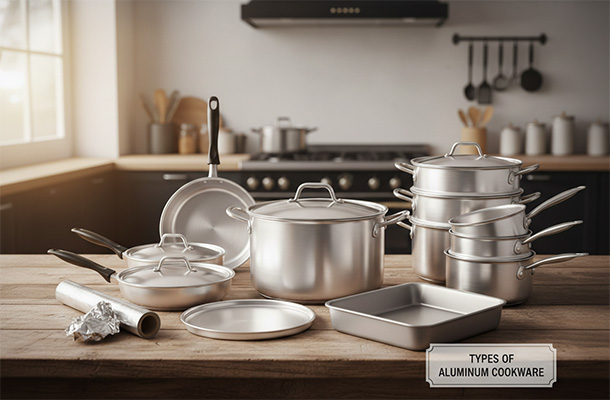
After 27 years in kitchenware manufacturing, I have seen how aluminum cookware choices make or break wholesale programs. Understanding product types helps buyers build stronger ranges that actually sell.
Why Does Aluminum Cookware Remain a Core Category in Global Wholesale?
Buyers keep choosing aluminum cookware for good reasons. It offers practical benefits that other materials struggle to match. Weight matters when customers handle products in stores.
Aluminum cookware stays popular because it is lightweight, conducts heat well, works across all price ranges, and fits mass market to premium retail channels effectively.
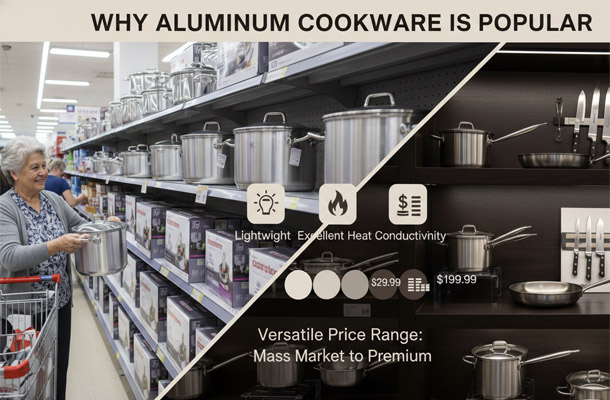
Aluminum gives buyers flexibility that stainless steel and cast iron cannot match. You can create entry-level sets under $30 or premium ranges over $200. The material works for discount stores and high-end kitchen specialty shops. Heat conductivity beats stainless steel in most price brackets. Weight stays manageable for older customers who struggle with heavy cookware.
I work mainly with stainless steel at my factory, but I understand why our wholesale customers often need aluminum options too. Aluminum fills gaps in product ranges where stainless steel costs too much or weighs too much. Smart buyers use both materials to cover more customer needs and price points.
What Are the Main Types of Aluminum Cookware Products in the Market?
Different aluminum cookware types serve different cooking habits and retail needs. Fry pans and skillets lead most product ranges. They sell in high volumes across all channels.
Main aluminum cookware types include fry pans, saucepans, stock pots, casseroles, woks, grill pans, and complete cookware sets. Each type targets specific cooking methods and customer preferences.
Fry pans and skillets form the foundation of most aluminum cookware programs. Customers buy these items most often, and they work well for testing new brands or price points. Sizes typically range from 8 inches to 12 inches, with 10-inch and 11-inch being the volume sellers.
Saucepans serve different cooking needs and usually sell in 1-quart, 2-quart, and 3-quart sizes. Customers use these for sauces, heating milk, cooking grains, and small-batch cooking. The market prefers long handles over helper handles for most saucepan sizes.
Stock pots and large casseroles target customers who cook for families or entertain guests. These items often have higher margins because customers buy them less frequently. Dutch oven style casseroles with tight-fitting lids work well in premium aluminum ranges.
Woks and sauté pans appeal to customers who want versatility. Aluminum woks heat up faster than carbon steel options, making them popular in Western markets. Sauté pans with straight sides work for both stovetop and oven cooking.
Cookware sets bundle multiple pieces at attractive price points. Sets typically include 7 to 12 pieces with fry pans, saucepans, and stock pots. Customers perceive better value in sets, even when individual pieces cost more per item.
How Does Aluminum Cookware Differ by Construction and Market Position?
Construction methods create different products for different market segments. Pressed aluminum serves budget-conscious customers. Forged and die-cast aluminum target higher price points with better performance.
Aluminum cookware construction ranges from pressed aluminum for budget markets to die-cast and anodized aluminum for premium positioning. Construction affects weight, durability, heat distribution, and retail price points.
Pressed aluminum cookware dominates entry-level and cost-sensitive programs. Manufacturing costs stay low, and final prices appeal to budget shoppers. Thickness ranges from 2.0mm to 3.0mm for most items. Heat distribution works adequately for basic cooking tasks, but hot spots can develop with high-heat cooking.
Forged aluminum cookware offers stronger perceived value for mid-range retail programs. The forging process creates denser metal structure and better heat distribution. Thickness typically ranges from 3.0mm to 4.0mm. Customers feel the quality difference when they handle forged aluminum pieces in stores.
Die-cast aluminum cookware provides heavier feel and thicker body construction for premium positioning. Die-casting allows complex shapes and integrated features like pouring spouts or textured surfaces. Base thickness often reaches 4.5mm to 6.0mm, creating excellent heat retention and even cooking.
Anodized aluminum cookware adds surface treatment for upgraded durability and appearance. Anodization creates harder surface that resists scratches and staining. Colors beyond natural aluminum become possible, appealing to design-conscious customers. Anodized surfaces also reduce metal transfer to food.
The same fry pan category performs very differently depending on construction method. A pressed aluminum 10-inch fry pan might retail for $15, while a die-cast anodized version sells for $45. Understanding these differences helps buyers match products to their target customers and price positioning.
Which Aluminum Cookware Types Fit Different Sales Channels?
Different sales channels need different product approaches. Mass retail focuses on core items and practical pricing. Specialty channels want broader ranges with unique features and better margins.
Mass retail prefers basic aluminum cookware at competitive prices, while kitchenware distributors need variety and e-commerce sellers want visual appeal. Premium retail focuses on design and upgraded construction methods.
Mass retail and discount channels usually prefer core items with practical pricing. Fry pans in 8-inch, 10-inch, and 12-inch sizes sell consistently. Basic saucepan sets with 1-quart, 2-quart, and 3-quart pieces appeal to budget shoppers. Simple cookware sets with 7 to 10 pieces hit target price points under $50.
Kitchenware distributors need broader product mixes with items that generate repeat volume. Specialty pieces like grill pans, woks, and roasting pans help differentiate their offerings. Mid-range construction with forged aluminum or basic anodizing provides better margins than pressed aluminum commodities.
E-commerce sellers care about visual appeal, set combinations, and consumer-friendly features. Colorful anodized finishes photograph well online. Cookware sets with attractive packaging and clear piece descriptions convert better in online listings. Induction compatibility becomes important as more customers cook on induction cooktops.
Premium retail channels focus on design, thickness, coating quality, and packaging presentation. Die-cast construction with 4.0mm+ thickness appeals to serious home cooks. Advanced non-stick coatings or ceramic-reinforced surfaces justify higher price points. Gift-worthy packaging helps drive sales during holiday seasons.
What Should Wholesale Buyers Look at Beyond Product Type?
Product type alone does not determine success. Construction details, coating quality, handle design, and compatibility features often make the difference between basic commodities and competitive product lines.
Key aluminum cookware evaluation factors include base thickness, interior coating, handle materials, lid quality, induction compatibility, and packaging design. These details affect performance, durability, and customer satisfaction.
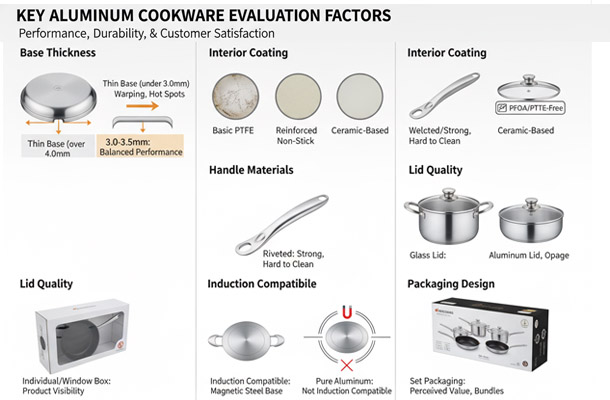
Base thickness directly affects cooking performance and durability. Thin bases under 3.0mm tend to warp on high heat and create hot spots. Thick bases over 4.0mm provide even heat distribution but increase costs and weight. Most successful mid-range programs use 3.0mm to 3.5mm thickness for good balance.
Interior coating quality determines non-stick performance and longevity. Basic PTFE coatings work for budget programs but may not last long with heavy use. Reinforced coatings with titanium or ceramic particles provide better durability. Some premium lines use ceramic-based coatings for customers who avoid traditional non-stick surfaces.
Handle materials and attachment methods affect safety and durability. Riveted handles provide strong attachment but create cleaning challenges around rivet areas. Welded handles offer cleaner appearance but may not withstand heavy commercial use. Silicone or soft-touch grip materials improve comfort but add costs.
Lid options can differentiate similar cookware ranges. Glass lids let customers monitor cooking progress but add fragility concerns. Aluminum lids match cookware appearance and resist breakage but block visibility. Tight-fitting lids improve cooking performance for braising and steaming.
Induction compatibility becomes increasingly important as induction cooktops gain popularity. Pure aluminum does not work on induction, so manufacturers add steel or iron disc bases. Quality of magnetic base attachment affects long-term durability and cooking performance.
Packaging design influences customer perception and retail presentation. Individual item packaging protects products but increases costs. Set packaging with window displays helps customers see product quality. Sustainable packaging materials appeal to environmentally conscious customers.
How Can You Build a Stronger Aluminum Cookware Range for Your Market?
Successful aluminum cookware ranges balance core items, specialty pieces, and different price levels. Starting with proven sellers reduces risk while specialty items help expand customer base and margins.
Strong aluminum cookware ranges start with core fry pans and saucepans, add cookware sets for value perception, include specialty items for differentiation, and balance entry-level with upgraded options.
Core items should usually come first in range development. Fry pans in 8-inch, 10-inch, and 12-inch sizes provide foundation volume. Saucepan sets with multiple sizes serve basic cooking needs. These items have proven demand across most markets and customer segments.
Cookware sets increase perceived value and average transaction size. Sets with 7 to 10 pieces typically perform well, including fry pans, saucepans, and one larger pot. Customers see better value in sets even when per-piece costs are higher. Sets also simplify purchasing decisions for gift buyers and new households.
Specialty items help expand the product line and serve specific cooking preferences. Woks appeal to stir-fry enthusiasts. Grill pans target customers who want grill marks without outdoor grilling. Roasting pans serve holiday cooking needs. These items often carry higher margins but sell in lower volumes.
Balancing entry-level and upgraded items improves overall range appeal. Entry-level pressed aluminum pieces attract budget-conscious customers. Mid-range forged aluminum options serve customers who want better quality. Premium anodized or die-cast pieces appeal to cooking enthusiasts willing to pay more.
Range success depends on understanding your target customers and sales channels. Mass retail needs focus on core items with competitive pricing. Specialty retail can support broader ranges with premium options. Online channels benefit from attractive packaging and clear feature descriptions.
Conclusion
Aluminum cookware offers commercial flexibility across price points and channels. Success comes from matching product types, construction methods, and features to target customers and sales strategies effectively.