
I still remember visiting two cookware booths at a trade show. The fry pans looked almost the same. One was quoted at $3.80, while the other was over $9.00. Many buyers face this same confusion.
Aluminum cookware can have very different prices because of construction methods, thickness, coating quality, induction compatibility, and quality control standards. Products may look similar outside, but their manufacturing cost and long-term performance can be completely different.
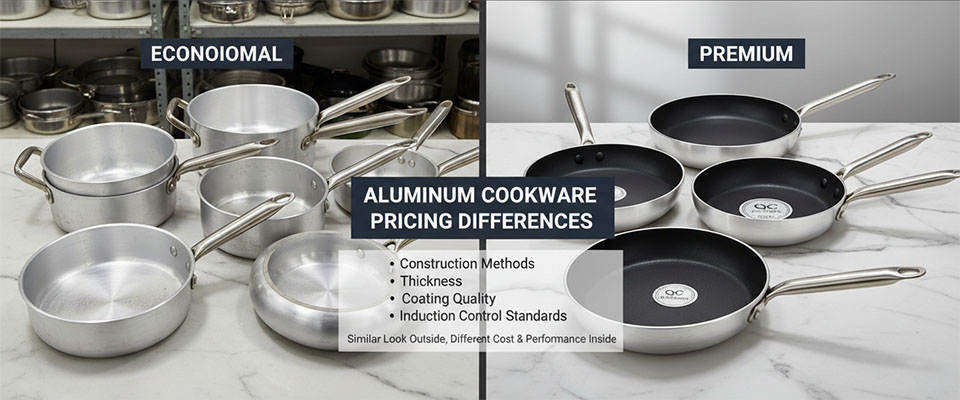
Many importers compare cookware mainly by appearance. That is normal because product photos and catalogs often look very similar. Still, cookware pricing is usually decided by hidden production details. I have seen many buyers choose the lowest quotation first, then later face customer complaints, coating issues, or unstable product quality. This is why understanding the real cost factors matters so much in the cookware business.
Does Aluminum Cookware Construction Affect Price the Most?
Many aluminum pans may look the same outside. Still, the construction method behind them can completely change the product cost and performance.
Pressed aluminum cookware is cheaper because it uses thinner aluminum sheets and simpler production methods. Forged and die-cast cookware need more material, more machine pressure, and more production time, which increases the price.
The most common aluminum cookware constructions are pressed aluminum, forged aluminum, and die-cast aluminum. Pressed aluminum is made by stamping sheets into shape. This process is fast and low cost. Forged aluminum uses high pressure to create denser, stronger structures. Die-cast aluminum uses molten aluminum in molds, creating the thickest and most stable bodies.
At INOXICON, we have been manufacturing all three construction types since 1997. Our 95 advanced machines produce over 30,000 pieces daily, giving us deep insight into how different methods affect cost and quality. The material cost difference alone can be 40-60% between pressed and die-cast versions.
| Construction Type | Material Usage | Common Market |
|---|---|---|
| Pressed Aluminum | 30% less material | Budget retail |
| Forged Aluminum | Standard thickness | Mid-range market |
| Die-Cast Aluminum | 50% more material | Premium cookware |
Through our 27 years of working with 500+ clients worldwide, I have learned that matching construction method to your target market expectations is crucial for long-term success. Different markets need different cookware structures based on price expectations and performance requirements.
Why Does Aluminum Thickness Create Huge Price Differences?
Thickness is one of the biggest hidden cost factors in aluminum cookware manufacturing. Many products look similar online, but the material thickness may be completely different.
Thicker aluminum cookware costs more because it uses more raw material, increases production weight, and usually requires stronger manufacturing processes. It also improves heat retention and reduces warping problems.
Some low-cost cookware uses very thin aluminum bodies to reduce production cost and shipping weight. Still, thin cookware often heats unevenly and may deform after repeated heating. I have tested pans with 1.2mm thickness that warped after just a few uses on high heat.
Thicker cookware distributes heat more evenly and gives better cooking stability. In European and North American markets, consumers often expect cookware to feel solid and durable. Because of this, many importers prefer thicker aluminum structures even though the product cost becomes higher.
Shipping cost is another factor. Thicker cookware increases total weight, affecting container loading and freight cost. Having completed over 1,200 projects at INOXICON, our in-house production control helps us manage these material costs more effectively than many competitors, keeping prices stable even during market fluctuations.
| Thickness Range | Heat Distribution | Common Use |
|---|---|---|
| 1.5mm–2.0mm | Quick heating | Budget lines |
| 2.5mm–3.0mm | Even heating | Mid-range retail |
| 3.5mm+ | Superior heat retention | Premium cookware |
Different regions have different expectations. Some developing markets focus heavily on pricing. Other markets care more about cooking experience and long-term durability.
Why Can Similar Nonstick Aluminum Cookware Perform So Differently?
Many nonstick aluminum pans look almost identical on store shelves. Still, their coating performance can be completely different after several months of use.
The quality of nonstick cookware depends heavily on coating materials, layer structure, surface preparation, and curing process. Better coatings increase manufacturing cost but reduce customer complaints and product returns.
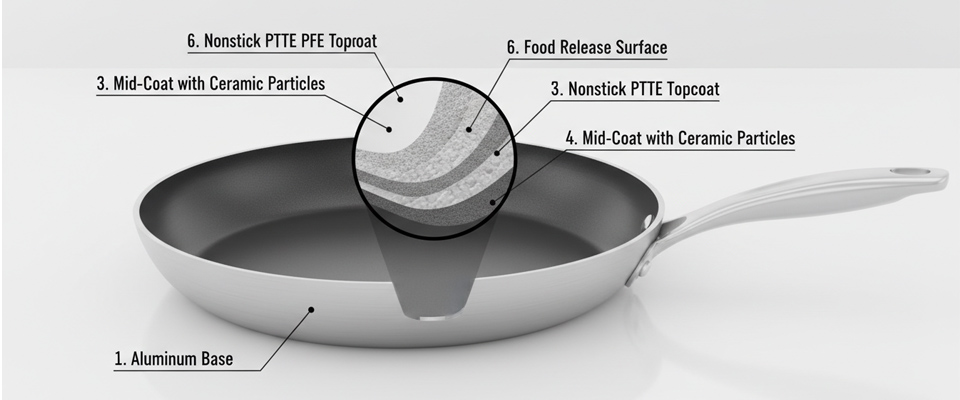
Some factories reduce coating costs to offer lower quotations. At first, the products may look attractive. But after customers use them for a short time, the coating may scratch, peel, or lose nonstick performance.
Good coating systems need proper surface treatment before spraying. We use sandblasting and chemical cleaning to create proper surface roughness. After coating application, products need stable baking temperatures and curing control. Many low-cost factories skip proper curing to save energy costs.
Our design team of five senior designers with 15+ years of experience works closely with engineers to ensure every coating process meets international standards. Multi-layer coatings perform better than single-layer coatings. A good 3-layer system costs about 60% more than basic coating, but the performance difference is significant.
| Coating Quality Level | Expected Lifespan | Cost Impact |
|---|---|---|
| Basic (1-layer) | 6-12 months | Baseline |
| Standard (2-layer) | 12-24 months | +30% cost |
| Premium (3+ layers) | 24-36 months | +60% cost |
Coating quality directly affects online reviews today. Many consumers leave bad reviews quickly when cookware coating fails. For many importers, stable coating quality matters more than saving a few cents on production cost.
How Do Induction Bases and Handle Systems Affect Pricing?
Many buyers underestimate how much induction bottoms and handle systems affect cookware pricing. These components can add 20-40% to total manufacturing cost.
Induction-compatible cookware costs more because aluminum itself does not work on induction cooktops. Additional stainless steel induction bases and stronger assembly systems increase production cost.
Pure aluminum does not work on induction, so we need to add magnetic materials. Some products use simple induction discs attached to the bottom. Others use full induction bases that improve heat transfer. Full induction systems cost more but provide better performance - a full stainless steel base uses 3-4 times more steel than a simple disc.
Handles are another hidden cost factor. Cheap cookware often uses weak rivets or unstable handle connections. After months of use, loose handles become major complaint issues. Premium products use stay-cool handles or oven-safe structures, increasing both complexity and material cost.
| Component | Basic Version | Premium Version | Cost Difference |
|---|---|---|---|
| Induction Base | 8cm disc | Full coverage base | +25-30% |
| Handle Material | Standard plastic | Bakelite/Silicone | +40-50% |
| Assembly Method | Basic | Precision welding | +10-15% |
Handle failure creates safety risks, which can lead to serious liability issues. I have seen buyers focus on cookware body appearance while ignoring handle quality, only to face complaint problems later.
Why Are Certification and Quality Control Also Part of the Price?
Many buyers compare quotations without considering testing and compliance costs. Still, certifications and QC systems are becoming more important in global cookware business.
Reliable cookware factories invest heavily in quality control, compliance testing, and production inspection. These systems increase manufacturing cost but help reduce long-term risks for importers and retailers.
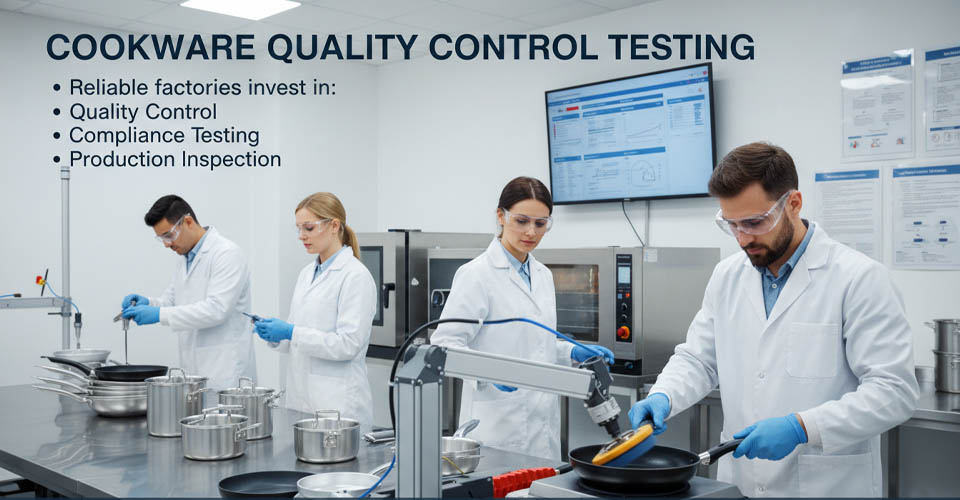
For export markets, cookware often needs to meet FDA, LFGB, or REACH standards. A complete testing package for one product line can cost $3,000-8,000. At INOXICON, we inspect every 500 pieces during production. This adds labor cost but prevents quality problems from reaching customers.
Experienced manufacturers understand what different markets expect, helping buyers avoid compliance problems later. New factories may offer lower prices, but they often lack testing equipment and quality systems needed for international markets.
Since 1997, we have learned that investing in proper quality systems actually reduces total cost by preventing expensive recalls and customer complaints. Our strict quality control is why we maintain partnerships with clients across 50+ countries.
| Quality Investment | Cost Impact | Long-term Benefit |
|---|---|---|
| Material testing | +2-3% | Prevents recalls |
| Production inspection | +3-5% | Reduces defects |
| Compliance certification | +1-2% | Enables export |
The total quality investment may add 7-11% to production cost. But it significantly reduces risks of product recalls, customer complaints, and market access problems. Our low MOQ policy starting from 500 pieces allows importers to test markets without heavy inventory pressure, while our optimized production delivers products up to 40% faster than competitors.
Conclusion
Similar aluminum cookware products may look nearly identical outside, but their real manufacturing cost can vary greatly. Construction methods, thickness, coating quality, induction systems, and quality control standards all create significant price differences while determining long-term product performance and customer satisfaction.