
Your colanders look great, but customers are complaining about rust. This common issue erodes profit margins and, more importantly, your brand's reputation. Choosing the right stainless steel from the start prevents these costly business problems and builds customer trust.
For most wholesale buyers, 304 stainless steel is the better choice for colanders. Its superior corrosion resistance significantly reduces rust complaints and protects your brand's reputation, making it a safer long-term investment for supermarkets, private labels, and quality-sensitive markets compared to the lower-cost 201 stainless steel.
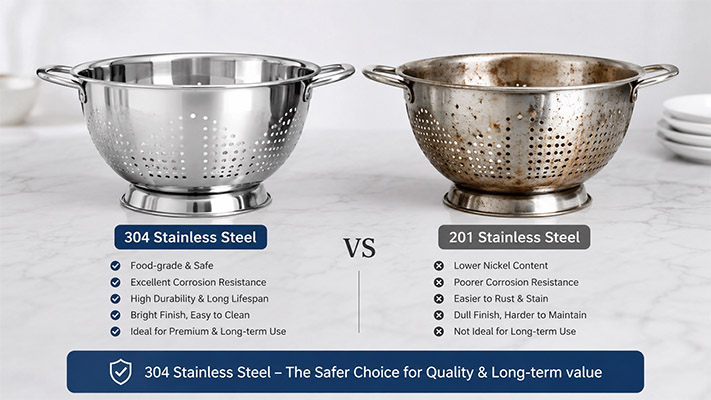
On the surface, 201 and 304 stainless steel look almost identical when they leave the factory. They both have that bright, clean finish that appeals to consumers. But as a manufacturer with over 27 years of experience at INOXICON, I've seen firsthand how this initial similarity can be misleading. The real difference isn't just in the price tag; it’s in the long-term value, the customer experience, and ultimately, your brand's reputation in a competitive market. After thousands of projects, I can tell you that the choice between these two materials is one of the most critical decisions an importer or brand owner can make. Let’s break down what really matters for your business.
What is 201 Stainless Steel, and Is It a Smart Business Move?
You need a low-cost option to compete on price, but you're worried about sacrificing the quality your brand stands for. I can help you understand if 201 steel is a strategic tool or a hidden liability for your specific market.
201 stainless steel is a lower-cost grade with less nickel and more manganese than 304. It is a smart business move only for highly price-sensitive markets or short-term promotional items where the risk of exposure to corrosive elements like salt and dishwashers is minimal.
From my experience producing millions of kitchenware items, I see 201 stainless steel as a specific tool for a specific job: winning on price. Its chemical composition, with a higher percentage of manganese and a lower percentage of nickel, makes it significantly more affordable to produce. This is why we often use it for clients targeting discount retail channels, dollar stores, or large-scale promotional giveaways where the primary purchasing driver is the lowest possible cost. However, I always counsel my clients that this choice comes with a clear trade-off. The lower nickel content makes 201 steel less resistant to corrosion. In a real-world kitchen, this means it is more susceptible to rusting when it comes into contact with salt, acidic foods like tomatoes or citrus, and harsh dishwasher detergents. Choosing 201 isn't inherently "bad," but it must be an informed and strategic decision. You are consciously trading long-term durability for a lower upfront cost, which can be very profitable if you align the product with the right customer expectations.
Why is 304 Stainless Steel Often the Safer Bet for Your Brand?
You want to build a reputable private label or become a trusted supplier to premium retail stores. You simply cannot afford the flood of customer complaints about rust or poor durability. Investing in 304 steel is your best insurance policy against these risks.
304 stainless steel, often marketed as 18/8 grade, offers superior corrosion resistance due to its high chromium and nickel content. It is the safer, more reliable choice for supermarkets, private labels, and any sales channel where product longevity and positive reviews are crucial for long-term business success.
Whenever a client comes to me with plans to launch their own kitchenware brand or supply major retailers in North America or Europe, I almost always guide them toward 304 stainless steel. The slightly higher unit cost is not an expense; it's an investment in brand protection. Think about the modern consumer's daily routine: they're washing pasta, rinsing acidic fruits for a smoothie, and then tossing the colander straight into the dishwasher for convenience. These are all activities that relentlessly test a product's durability. 304 stainless steel, with its robust composition of approximately 18% chromium and 8% nickel, is specifically engineered to withstand this daily abuse far better than 201. For importers targeting these quality-sensitive markets, 304 is often the unspoken standard that meets local regulations (like FDA and LFGB) and, more importantly, consumer expectations for food-safe, dishwasher-safe, and long-lasting kitchenware. By choosing 304, you are proactively minimizing the risk of returns, negative online reviews, and the customer service headaches that follow.
Why Do Rust Complaints Matter More Than the Initial Unit Price?
You saved 20 cents per unit by choosing a cheaper material, which felt like a win. But now, negative reviews about "rust spots" are dragging down your product's rating and hurting sales velocity. This is a common and very costly business trap.
Rust complaints directly attack your brand's credibility and can lead to delistings, costly returns, and a permanent loss of customer trust. A single rust spot makes a consumer question the product's safety and quality, creating a negative perception that is far more expensive than any initial material savings.
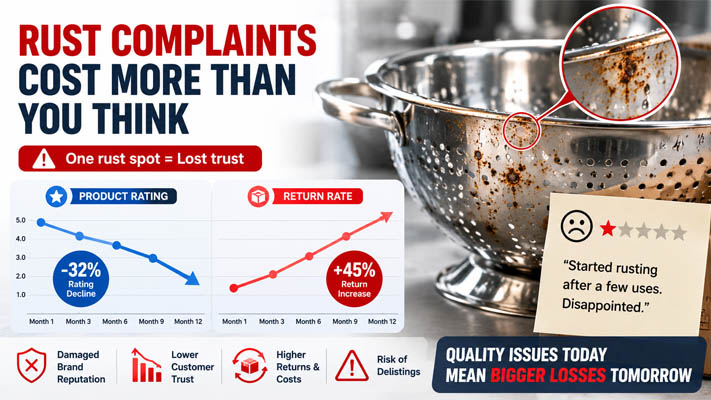
I've had countless conversations with purchasing managers who are under immense pressure to reduce the FOB price. It’s a core part of their job, and I respect that. However, focusing too narrowly on unit cost is a short-sighted strategy. The average consumer doesn't understand the chemistry of austenitic versus manganese-based stainless steel; they just see a product labeled "stainless" that is now stained with rust. That single rust spot invalidates the product's core promise in their eyes. For your business, this single visual flaw translates into tangible, expensive problems that ripple through your operations.
| Business Metric | Impact of High Rust Complaints |
|---|---|
| Product Ratings | Your average star rating drops, immediately deterring new buyers on platforms like Amazon. |
| Return Rate | Increased returns lead to direct logistical costs, lost revenue, and potential penalties from retailers. |
| Customer Service Load | Your team is tied up handling angry customers and processing refunds instead of focusing on growth. |
| Brand Reputation | Your private label, which you've invested in, is now perceived as "cheap" or even "unsafe." |
| Retailer Confidence | Buyers from large chains see the high return rate and poor reviews, and they will refuse to reorder. |
As you can see, the initial cost savings from using a lower-grade material can be quickly erased—and then surpassed—by the long-term costs of a damaged reputation. Investing in a material like 304 stainless steel is a proactive business decision to protect your entire commercial ecosystem.
Beyond Steel: What Manufacturing Details Define a Quality Colander?
You made the right call and chose 304 steel, but you're still getting some complaints. Customers report water getting trapped in the rim or a family member getting scratched on a sharp edge. The material grade is only part of the quality equation.
Yes, even a 304 stainless steel colander can be a failure if manufactured poorly. Critical details like welding quality, rim finishing, hole punching, and final polishing are what separate a premium product from a potential liability, regardless of the steel used.
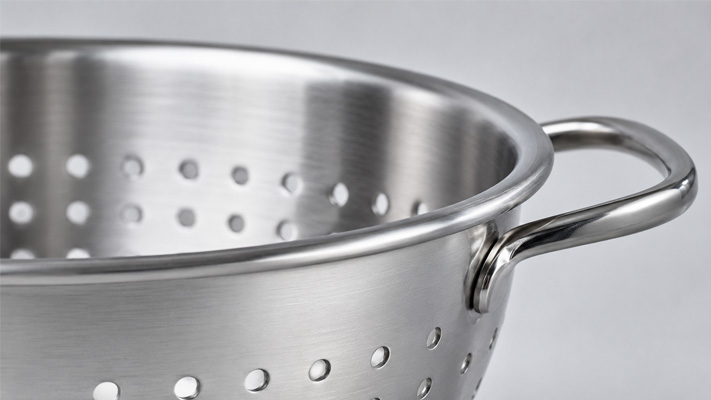
As a manufacturer, this is where our 27 years of expertise truly shines. The raw material is the foundation, but the craftsmanship is what defines the final product's safety and performance. Many of the consumer complaints we analyze are not about the steel's chemistry but about how it was handled during production. For instance, rust often appears first at the weld points connecting the feet or handles. This happens because the intense heat from welding can temporarily alter the steel's structure, making it more vulnerable to corrosion if not properly treated and polished afterward. Another common issue is a poorly designed rolled rim; if not sealed perfectly, it creates a tiny crevice that traps water and food particles, becoming a hidden area for bacteria and rust. At INOXICON, our quality control process focuses intensely on these details, ensuring every product is not just made from the right material but is also constructed to the highest standard of safety and durability.
How Can You Verify Quality Before Placing a Bulk Order?
You've received samples that look perfect, but how can you be sure the final bulk production will match this quality? Trust is good, but verification is better for protecting your investment and your brand.
To verify quality, you must move beyond visual inspection. A robust verification process includes requesting material certificates, conducting practical stress tests, and scrutinizing manufacturing details like welding, polishing, and packaging on the pre-production samples.
Over the years, I've developed a checklist with my clients to ensure they are not caught by surprise. A shiny sample in a showroom doesn't tell you how it will perform after 50 dishwasher cycles. Before committing to a large order, you need to simulate real-world use and abuse. First, always ask your supplier for a material composition certificate. For critical orders, a handheld XRF (X-ray fluorescence) analyzer can instantly verify the grade. Second, put the sample to work. Wash it repeatedly in a dishwasher, let it sit with salty water, and wipe the surface with a clean white cloth to check for any black polishing residue. Third, get hands-on. Run your fingers carefully around the holes and rim to check for sharp burrs. Fill it with something heavy to test the handle and foot welds. Check if the rim or base traps water after washing. Finally, inspect the packaging to ensure it will protect the product from scratches during its long journey from our factory to the end consumer. This level of diligence turns you from a simple buyer into a true quality partner.
Conclusion
Choose 201 steel only for specific, price-driven strategies where you can manage customer expectations. For building a lasting brand and ensuring long-term profitability, 304 stainless steel is almost always the smarter, safer investment.