
A large cookware set may look valuable, but unnecessary pieces increase costs, occupy warehouse space, and make the final price harder to justify.
A successful cookware set combines frequently used cookware with clearly different functions. Each piece should support daily cooking, strengthen the product concept, or increase perceived value without creating excessive production, packaging, and inventory costs.
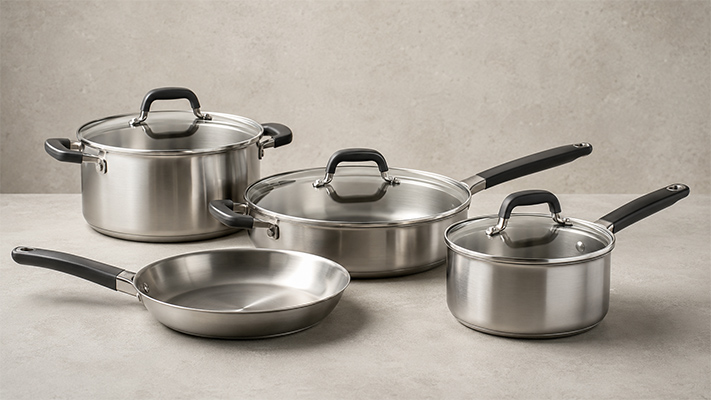
Set development should not begin by selecting random items from a factory catalog. It should begin with cooking tasks, sales evidence, price positioning, and the practical cost of delivering the complete set.
Why Do More Pieces Not Always Create a Better Cookware Set?
Adding more pieces can make a set appear competitive. However, customers quickly notice duplicated sizes, impractical cookware, and accessories included mainly to increase the advertised count.
A higher piece count only creates value when the additional items expand useful cooking functions. Lids, utensils, inserts, and protectors may increase the number printed on the box, but they do not necessarily make the cookware set more practical.
A “10-piece set” may contain only five cooking vessels because every lid is counted separately. This is acceptable when the five vessels form a useful combination. The problem appears when the set contains small pans, repeated capacities, or accessories that customers rarely use.
Each additional item also affects material consumption, assembly time, carton size, warehouse space, and final retail price.
| Set Element | Possible Value | Commercial Risk |
|---|---|---|
| Second frying pan | Covers another portion size | May duplicate an existing pan |
| Large stockpot | Supports family-size cooking | Significantly increases carton volume |
| Shared lid | Reduces weight and cost | Requires accurate rim compatibility |
| Steamer insert | Adds another cooking method | Demand varies by market |
| Utensils or protectors | Improve presentation | May be viewed as filler |
A compact set with six useful pieces can offer stronger value than a twelve-piece set built around an inflated count.
How Can Sales Evidence Guide Set Composition?
Choosing only from available molds is convenient, but it can produce a set based on factory availability rather than real demand.
Review successful products, customer feedback, individual cookware sales, and return reasons before deciding the combination. Focus on actual cooking vessels, sizes, capacities, price points, and repeated complaints instead of relying only on advertised piece counts.
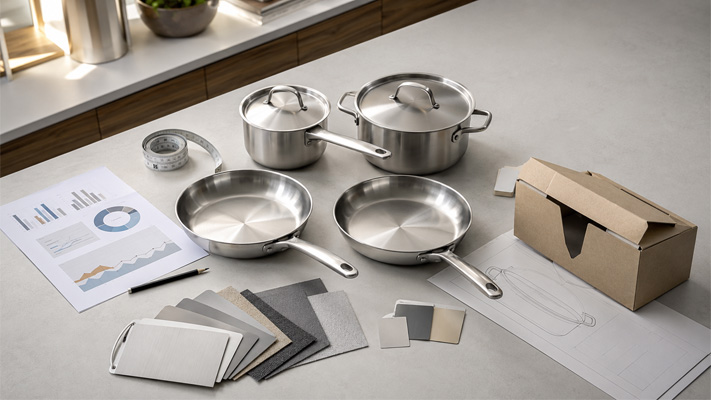
Begin by comparing 20 to 30 strong-selling sets within the intended price range. Record the actual number of pans, their dimensions, materials, construction, lids, package size, and retail positioning.
Customer reviews can reveal problems that product listings hide. Look for repeated comments such as:
- The small frying pan is rarely used.
- Two saucepans feel almost identical.
- The set needs a larger everyday pan.
- The stockpot is too large for normal storage.
- Handles make the cookware difficult to stack.
- The coating scratches during storage.
- A replacement lid is difficult to obtain.
Individual cookware sales provide another useful signal. If a certain frying pan or saucepan sells strongly on its own, it may become a reliable foundation for a complete set.
Sales research does not remove all risk, but it makes the initial combination easier to defend and improve.
How Should a Set Be Built Around Hero Pieces?
Without a clear hero product, a cookware set can feel like a collection of unrelated pans. It becomes difficult to communicate why customers should choose it.
Select one or two hero pieces that represent the set’s main promise. Then add supporting cookware that covers different cooking tasks, portion sizes, and capacities without competing with the hero products.
A hero piece is usually the item that attracts attention and receives the most frequent use. Depending on the product concept, it could be:
- A 10- or 12-inch frying pan for everyday cooking
- A deep sauté pan for frying, braising, and one-pan meals
- A medium casserole for family cooking
- A multifunctional chef pan with a lid
- A removable-handle pan designed for compact storage
The supporting pieces should complete the cooking range. A medium saucepan handles sauces and reheating, while a larger casserole supports soup, pasta, and shared meals.
| Product Role | Purpose | Example |
|---|---|---|
| Hero piece | Creates the main sales reason | Large frying pan |
| Daily-use piece | Handles frequent small tasks | Medium saucepan |
| Capacity piece | Supports larger meals | Casserole or stockpot |
| Value piece | Adds utility at controlled cost | Shared lid or steamer |
The construction should also match the positioning. A premium set may use tri-ply stainless steel, while an entry-level set may use stainless steel with an impact-bonded base.
How Can Overlapping Sizes and Low-Use Functions Be Removed?
Cookware with different names may perform almost the same task. When those products appear together, one often becomes the slow-moving or rarely used piece.
Compare every item by usable capacity and cooking function. Remove a product when its role cannot be clearly separated from another pan, unless the size difference supports a distinct household portion or cooking method.
Do not evaluate a pan only by its category name. A deep frying pan, shallow casserole, chef pan, and sauté pan can have very similar dimensions and functions.
Use a simple test: When would the customer choose this piece instead of another one in the same set? If the answer is unclear, the combination probably contains functional overlap.
| Cookware Type | Main Function | Common Overlap |
|---|---|---|
| Frying pan | Frying, searing, quick cooking | Another pan with a similar diameter |
| Saucepan | Sauces, reheating, small portions | Milk pan with similar capacity |
| Sauté pan | Frying, braising, one-pan meals | Deep frying pan or shallow casserole |
| Stockpot | Soup, pasta, batch cooking | Large casserole |
| Steamer insert | Steaming and draining | Limited use in some markets |
Specialty pieces require stronger evidence. Grill pans, steamers, mini pans, and wok inserts can support a specific concept, but they should not be added only to make the set appear larger.
How Should Market Fit, Price, and Carton Size Be Balanced?
A useful combination can still perform poorly when its capacity, price, or packaging does not match the intended market and sales channel.
Match the cookware set to local cooking habits, household size, stove dimensions, storage conditions, target retail price, and delivery costs. Product value must be considered together with carton efficiency and shelf presentation.
American product descriptions commonly use inches and quarts, while many European and Asian markets use centimeters and liters. More importantly, preferred cookware shapes and capacities can change with local meals, household size, and kitchen space.
For Amazon, nesting performance and package dimensions deserve early attention. A large stockpot may force the entire set into a higher fulfillment size category. Heavy glass lids can increase both shipping costs and breakage risk.
Retail packaging must communicate the composition quickly. Customers should understand the actual pans, their sizes, and their main functions from the front or side panels.
Possible positioning options include:
- An entry set with a few essential pans
- A family set with larger cooking capacities
- A premium set with stronger construction and one distinctive pan
- A compact set with nesting bodies and removable handles
Shared lids, removable handles, storage lids, and protective pads can improve carton efficiency, but they should strengthen a clear product concept rather than serve as artificial piece-count additions.
How Can the Combination Be Tested Before Large-Scale Production?
A set may look balanced on paper but reveal problems during stacking, packaging, transport, or the first sales cycle.
Test several set combinations through samples or a controlled first order. Compare cookware weight, functional overlap, nesting, carton dimensions, packaging protection, presentation, and customer response before committing to a larger production program.
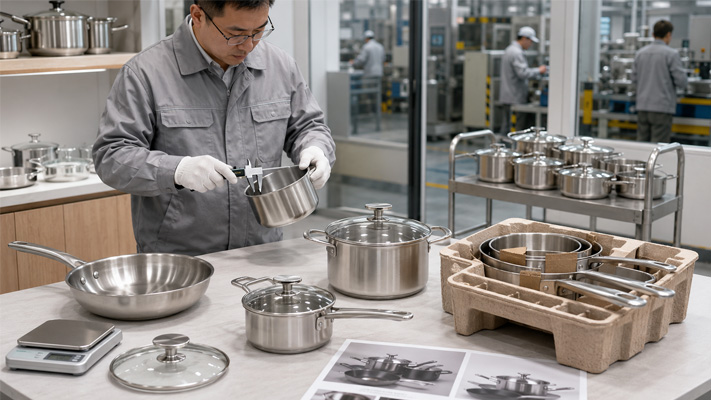
Existing molds can make early testing faster and less expensive. Instead of developing every component from the beginning, create two or three combinations around the same hero piece.
During sample evaluation, check:
- Whether bodies nest without scratching
- Whether handles waste carton space
- Whether shared lids fit securely
- Whether glass components remain protected
- Whether the carton is easy to carry and store
- Whether the set looks complete when unpacked
- Whether every pan has a clear use
The first order should also preserve flexibility. One item may need to be replaced, resized, or removed after real sales feedback becomes available.
INOXICON supports cookware set development through existing product options, custom specifications, branding, packaging development, and flexible production quantities. This allows new combinations to be tested before wider expansion.
Conclusion
Strong cookware sets are built around useful hero pieces, distinct cooking functions, suitable pricing, efficient packaging, and controlled testing—not the largest possible piece count.