
Cookware MOQ quotations can seem inconsistent. A quantity that works for pan bodies may be too low for coatings, handles, lids, or printed packaging.
Cookware set MOQ is determined by the component or process with the highest minimum requirement. Calculate the set-equivalent MOQ for cookware bodies, accessories, colors, logo processes, and packaging. The highest result becomes the practical minimum order quantity.
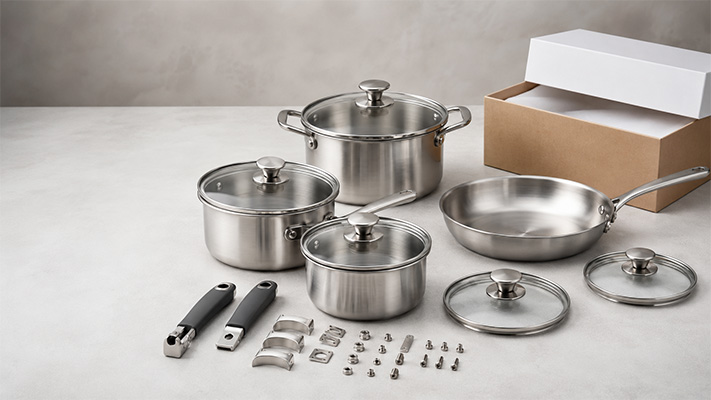
A cookware set is not one product from a production perspective. It is a group of components that must be produced, sourced, finished, inspected, and packed in the correct quantity. Understanding this structure helps avoid an MOQ that looks acceptable on paper but creates excess stock or unexpected costs later.
Why Cookware Set MOQ Is Not One Simple Number
A cookware set may be sold under one SKU, but it can include several cookware bodies, lids, handles, knobs, accessories, and packaging materials.
The MOQ of a cookware set cannot be calculated from total order quantity alone. Each body size, lid diameter, handle design, color, finish, and packaging version may have its own production minimum.
For example, a 10-piece cookware set does not normally contain ten different cookware bodies. The piece count may include glass lids, a steamer insert, or detachable handles.
One 10-piece set could include:
- One 16 cm saucepan and lid
- One 20 cm casserole and lid
- One 24 cm casserole and lid
- One 24 cm frying pan
- One 28 cm frying pan
- One steamer insert and lid
If the order is for 800 complete sets, the factory still needs to manufacture 800 units of each cookware body and source the required lids, handles, knobs, screws, inserts, and boxes.
It is useful to separate these terms before discussing MOQ:
| Term | Meaning in an MOQ quotation |
|---|---|
| Set | One complete retail unit with all listed components |
| Piece | One pan, pot, lid, handle, or accessory |
| SKU | One sellable product configuration |
| Variant | A different color, finish, set combination, or packaging version |
| Total order | The combined quantity of all sets and variants |
A quotation for “500 pieces” may mean 500 individual frying pans, rather than 500 complete sets. Always ask whether the MOQ applies per cookware body, per set, per color, per packaging design, or to the total order.
The Practical Formula for Calculating Cookware Set MOQ
Looking only at the MOQ for cookware bodies can lead to an unrealistic estimate. Every component must be converted into the number of complete sets it can support.
Divide each component’s minimum quantity by the number used in one set. The final cookware set MOQ is the highest set-equivalent MOQ among all components, production processes, and packaging materials.
The basic calculation is:
Component Set-Equivalent MOQ = Component MOQ ÷ Units Used per Set
Then:
Final Set MOQ = Highest Set-Equivalent MOQ Across All Required Items
For example, suppose a cookware set includes:
- One 20 cm casserole
- One 24 cm casserole
- One 24 cm frying pan
- Two glass lids
- Six identical handles
- One printed gift box
The minimum quantities may look like this:
| Item or process | Minimum quantity | Used per set | Set-equivalent MOQ |
|---|---|---|---|
| 20 cm casserole body | 500 pcs | 1 | 500 sets |
| 24 cm casserole body | 500 pcs | 1 | 500 sets |
| 24 cm frying pan body | 500 pcs | 1 | 500 sets |
| Glass lids | 1,000 pcs | 2 | 500 sets |
| Custom handles | 3,000 pcs | 6 | 500 sets |
| Printed gift boxes | 1,000 pcs | 1 | 1,000 sets |
The cookware itself supports a 500-set order. However, the printed gift boxes require 1,000 units. If the project requires fully printed gift boxes, the practical MOQ is therefore 1,000 complete cookware sets.
The final quantity may also need to be rounded up based on master carton packing. If each master carton holds four sets, a calculated order of 1,002 sets would normally be adjusted to 1,004 sets.
Unused packaging can sometimes be kept for a repeat order, but this should be agreed on in advance. Storage costs, revised artwork, changed set configurations, and slower-than-expected sales can make leftover packaging a risk.
How MOQ Changes at Different Customization Levels
Two cookware projects with the same set structure can have very different MOQ requirements. The main difference is usually the number of new variables introduced into production.
Existing cookware designs generally have the lowest MOQ. Branded packaging, exclusive colors, custom components, and new cookware structures each add separate production or sourcing minimums.
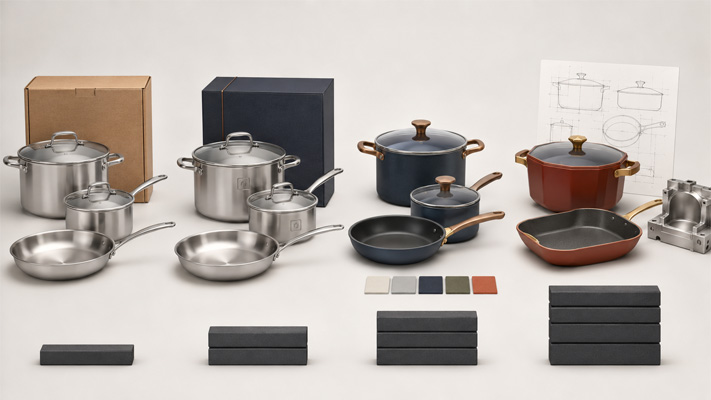
A practical way to assess a project is to divide it into four customization levels.
| Customization level | Typical requirements | Main MOQ driver |
|---|---|---|
| Standard set | Existing bodies, standard handles, available finish, neutral packaging | Basic production batch |
| Private label | Existing design, laser logo, labels, manuals, custom box | Printed packaging |
| Semi-custom | Exclusive color, coating, handle, lid, knob, or set combination | Color batch and component sourcing |
| Fully custom | New shape, dimensions, construction, and tooling | Tooling and independent production runs |
Standard Set
A standard set uses existing cookware bodies, standard components, and a proven production process. The set combination can often be adjusted without creating new tooling.
MOQ is mainly determined by the efficient production quantity for each cookware body. A small order containing many different pot and pan sizes can still be difficult because each size needs separate material preparation, forming, polishing, and quality inspection.
Private Label Set
Private label customization may include a logo, retail label, instruction manual, barcode sticker, or branded gift box. A laser logo often has less impact on MOQ than printed packaging.
This means a factory may be able to produce 500 cookware sets, while the box supplier requires 1,000 boxes. A low product MOQ is not necessarily a low project MOQ.
Semi-Custom Set
Semi-custom projects use existing cookware bodies but add an exclusive color, nonstick coating, handle, knob, lid, or set arrangement.
The cookware body tooling cost may remain low, but a coating supplier may require a minimum quantity for each color. Injection-molded handles may also have a separate MOQ by material and color. These requirements often control the final order quantity.
Fully Custom Set
A fully custom cookware project may require new stamping dies, casting molds, lid molds, handle molds, bonding tools, or assembly fixtures.
Tooling fees and production MOQ should be discussed separately. Paying for a mold does not automatically make a very small run practical. Material purchasing, machine setup, polishing, coating, testing, and inspection still need a workable batch size.
How Colors, Sizes, and Packaging Increase Final MOQ
A large total order can still fail to meet MOQ when it is divided across too many variants. Factories assess the quantity of each production configuration, not only the total quantity on the purchase order.
Every additional color, coating, size, logo version, or packaging design can create another MOQ. When a minimum applies per variant, multiply it by the number of variants to estimate the realistic order quantity.
For example, an order contains 1,200 cookware sets in three exterior colors. If the coating process requires at least 500 sets per color, an equal split gives only 400 sets per color.
Although the total order exceeds 1,000 sets, it does not meet the coating MOQ. The workable quantity becomes:
500 sets per color × 3 colors = 1,500 sets
Different cookware sizes create a similar issue. A 20 cm saucepan and a 24 cm casserole generally cannot be combined to meet one body MOQ because they require different material blanks, forming tools, and production settings.
However, some components can be shared to improve efficiency:
- Two casserole sizes can use one handle family.
- A frying pan and casserole can share one lid diameter.
- Several cookware sets can use the same knob and screw.
- Different set configurations can use one adjustable box structure.
- Multiple markets can use a common box with different barcode labels or manuals.
Packaging needs special attention because each item may have its own minimum:
- Printed gift boxes
- Corrugated master cartons
- Molded pulp or plastic inserts
- Instruction manuals
- Paper sleeves
- Barcode and warning labels
- Market-specific artwork
If three markets need three different printed boxes, the packaging supplier may treat them as three separate orders. A common box with market-specific labels, inserts, or manuals can often reduce the first-order MOQ.
How to Reduce Cookware Set MOQ Without Making the Set Generic
Lower MOQ does not have to mean removing every point of difference. The better approach is to customize the details customers notice while keeping production-intensive parts standardized.
Use existing cookware bodies and focus customization on logos, finishes, set composition, packaging, or selected shared components. Limit first-order variants and postpone new molds until market demand is proven.
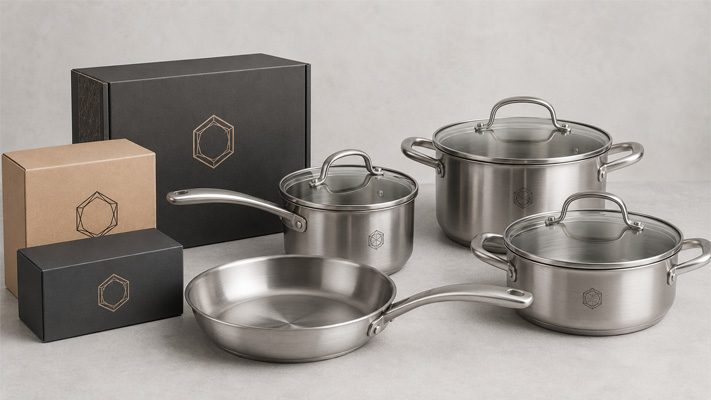
Use Existing Body Tooling
An established body shape can still feel distinctive through polishing, coating, handle selection, logo placement, and set composition. This avoids the cost and MOQ pressure of new forming or casting tools.
Share Components Across the Set
Using one handle family, knob, or lid design across several cookware sizes increases the purchase quantity of common components without increasing the number of completed sets.
Start With One Main Color
Launching three or four colors divides demand and creates separate coating batches. A core color can be introduced first, with additional colors added after sales data supports them.
Select a Flexible Logo Process
Laser engraving or pad printing may suit an initial order better than an embossed logo that needs new tooling. The right method depends on the material, surface finish, logo position, and durability requirements.
Simplify First-Order Packaging
A standard box with a printed sleeve, label, or insert can reduce the MOQ for fully printed gift boxes. Packaging should still protect the cookware properly during shipping, storage, and fulfillment.
Build a Core Set First
A focused set with the most useful sizes usually creates less inventory risk than a larger set containing slow-moving pieces. Extra pans, steamers, or utensils can be introduced later as extensions.
At INOXICON, we can review the proposed set structure before sampling and identify which customization choices are likely to determine the final MOQ.
What Should an RFQ Include for an Accurate MOQ?
An incomplete request can produce an attractive but unreliable MOQ. The quantity often changes after colors, packaging versions, materials, and custom components are confirmed.
An accurate RFQ should define the full set composition, dimensions, material, construction, finish, colors, logo method, accessories, packaging, market versions, target quantity, and expected annual volume.
Include:
- Cookware types and quantity used in each set
- Diameter, height, capacity, and material thickness
- Stainless steel, aluminum, cast aluminum, or multi-ply construction
- Interior and exterior surface treatment
- Nonstick coating type and testing requirements
- Number of colors and quantity per color
- Lid, handle, knob, and accessory requirements
- Logo position, size, and application method
- Retail packaging structure and artwork versions
- Master carton quantity and shipping requirements
- Required certificates or test reports
- Target quantity for the first order
- Expected annual purchasing volume
- Target launch date and destination market
Ask the manufacturer to show MOQ at three levels:
- Minimum sample or trial quantity
- Minimum efficient production quantity
- Minimum quantity for full customization
This comparison shows whether the main restriction comes from cookware production, accessory sourcing, surface processing, or packaging.
INOXICON supports OEM and ODM cookware projects from initial set planning through production. Sharing a complete RFQ early makes it easier to create a set structure that is differentiated, commercially practical, and suitable for the intended order volume.
Conclusion
Cookware set MOQ is set by the highest component, process, color, or packaging minimum. Calculate every requirement as complete sets before confirming the order quantity.