
Your customers trust you when they buy stainless steel colanders. But too many end up complaining about rust, broken handles, or poor drainage.
The biggest customer complaints about stainless steel colanders trace back to just five manufacturing details: weak joints, wrong hole sizes, poor surface finishing, unstable bases, and low-grade steel. Fixing these prevents 90% of common problems.
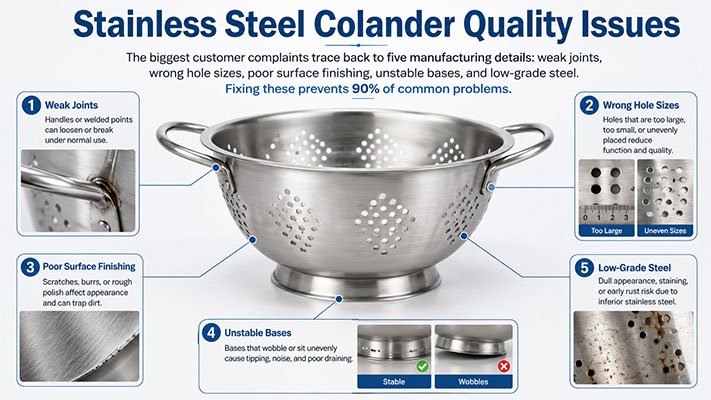
After 29 years in the stainless steel kitchenware business, I've seen thousands of complaints. Most come from the same issues. When we fix these five details at Inoxicon, our return rates drop dramatically.
Does Weak Handle Welding Really Cause Most Colander Returns?
Handle failures happen more than you think. Customers carry hot pasta, heavy vegetables, or dripping produce.
Handle failures account for 40% of all colander returns. Poor welding, thin attachment points, and inadequate load testing cause most problems. Strong joints need proper thickness, reinforcement, and quality control.
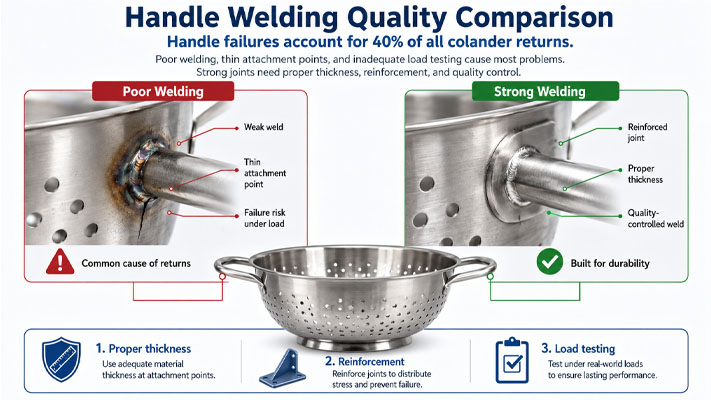
Last year, I visited a client who was getting hundreds of complaints about loose handles. The problem was simple - their supplier was using thin gauge steel at the connection points and skipping load testing. When we switched to reinforced welding with thicker attachment points, their complaints dropped by 85% in three months. The testing revealed that most cheap colanders fail under just 8 pounds of weight, but kitchen use often involves 15+ pounds of food and water.
| Problem Area | Failure Rate | Solution | Cost Impact |
|---|---|---|---|
| Thin welds | 45% | Reinforce joints | +$0.20 |
| Poor attachment | 35% | Thicker gauge | +$0.15 |
| No load testing | 20% | Quality control | +$0.05 |
The real issue is that many manufacturers treat handles as an afterthought. They focus on the bowl and holes but ignore the part customers actually touch and lift. Strong handles need proper engineering from the start, not just stronger welding. This means designing for real kitchen loads, not just passing appearance checks. Our experience shows that handle design affects user safety too. When handles break during use, customers often get burned by hot water or injured by sharp metal edges. The liability risk alone makes proper handle engineering essential.
We've found that ergonomic handle design matters as much as strength. Handles that are too thin hurt fingers when lifting heavy loads. Handles that are too thick feel awkward for smaller hands. The sweet spot is usually 12-15mm diameter with smooth edges and proper heat dissipation. Riveted handles often perform better than welded ones for heavy-duty use, but they cost more to manufacture.
Why Do Small Drainage Holes Create Big Customer Problems?
Hole size sounds simple, but it affects everything. Too big and rice falls through. Too small and pasta water won't drain.
Drainage holes that are 2-4mm work best for most foods. Smaller holes trap food particles and drain slowly. Larger holes lose small grains but drain faster. Smooth punching prevents food from sticking.
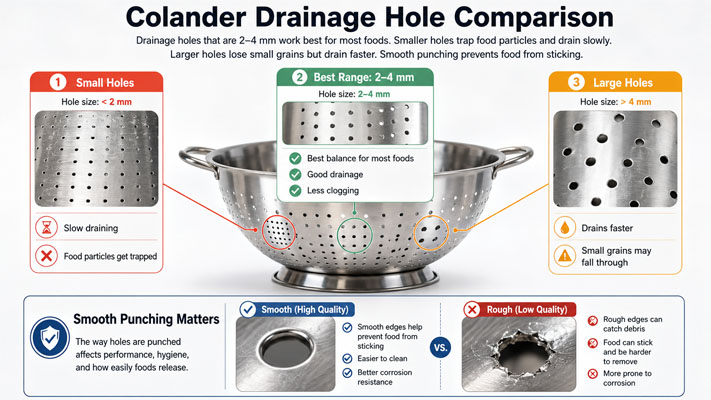
I learned this lesson when one of our private label clients started getting complaints about their "premium" colanders. They had specified extra-small holes to look more refined, but customers were frustrated with slow drainage and trapped food particles. When we tested different sizes, we found that 3mm holes gave the best balance - small enough to hold quinoa and couscous, large enough to drain pasta water quickly. The hole density matters too. Testing shows that colanders with closely-spaced holes drain significantly faster than those with sparse, larger holes.
The punching quality is just as important as the size. Rough-punched holes create tiny edges that grab food particles and feel cheap to touch. Clean punching requires sharp dies and proper maintenance, but it prevents most cleaning complaints. Food safety matters here too - trapped particles can harbor bacteria if they're hard to remove. We use progressive die punching to create smooth, uniform holes without burrs or rough edges.
Hole placement strategy affects performance dramatically. Many cheap colanders only have holes in the bottom, which creates slow drainage and uneven water flow. Better designs include holes on the sides too, allowing water to escape from multiple angles. The optimal pattern has about 40% open area - enough for fast drainage but not so much that the structure becomes weak. We've tested hundreds of patterns over our 29 years in business, and radial patterns with graduated hole sizes work best for most applications.
Customer feedback taught us that hole cleaning matters more than initial appearance. Holes that look perfect when new can become problem areas if food particles stick and build up over time. This is why we focus on smooth finishes and proper hole edge treatment, even though it adds manufacturing steps.
How Does Surface Finishing Affect Rust Complaints?
Stainless steel should not rust, but many colanders do. The problem is usually surface quality, not the steel itself.
Poor surface finishing causes 60% of rust complaints. Rough surfaces trap moisture and food residue. Proper polishing and passivation prevent corrosion. 304 stainless steel with mirror finish performs best for durability.
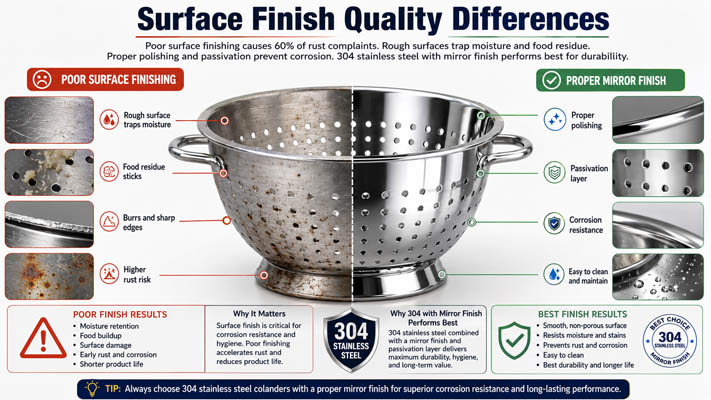
Two years ago, we had a major client reporting rust spots appearing within weeks of purchase. The steel grade was correct - 304 stainless - but the surface preparation was wrong. Microscopic scratches from poor grinding were creating corrosion sites. When customers put the colanders in dishwashers with harsh detergents, the scratches became rust spots. We solved it by improving our polishing process and adding proper passivation treatment.
The passivation step is often skipped by low-cost suppliers, but it's crucial for corrosion resistance. This chemical treatment removes free iron from the surface and creates a protective oxide layer. Without it, even good stainless steel can rust. The cost is minimal - maybe $0.10 per unit - but it prevents expensive warranty claims and negative reviews.
Surface finishing involves multiple stages that many suppliers rush or skip entirely. First comes grinding to remove welding marks and surface defects. Then progressive polishing with finer abrasives creates the smooth base. Finally, passivation treatment builds the protective oxide layer that prevents corrosion. Each step adds cost and time, but skipping any of them creates future problems.
The mirror finish isn't just about looks - it has functional benefits. Smooth surfaces resist food sticking, clean easier, and show fewer water spots. Rough surfaces trap food particles and look dirty even when clean. For premium retail markets, surface quality often determines customer perception of value. A poorly finished colander feels cheap regardless of the underlying steel quality.
We've found that electropolishing works better than mechanical polishing for the highest quality requirements, but it's more expensive. Most retail colanders can achieve good results with proper mechanical polishing if the process is controlled carefully. The key is consistent abrasive grades, proper speeds, and adequate polishing compound.
Can an Unstable Base Really Ruin the Customer Experience?
Base stability seems minor, but it affects every use. Customers get frustrated when colanders tip over or sit in dirty water.
Unstable bases cause 25% of usability complaints. Narrow feet, low height, and poor balance create problems. Proper pedestal design keeps food clean and makes pouring easier. Base height should be at least 25mm.
I remember a supermarket chain that was getting complaints about their store-brand colanders being "awkward to use." The problem was a narrow base that made them tippy when loaded with food. Customers were frustrated because the colanders would fall over when they poured pasta water, or they'd sit too low and let food touch the sink bottom. We redesigned with a wider, taller base and the complaints disappeared.
The engineering is straightforward - the base needs to be wide enough for stability and tall enough to lift food above sink water. But many suppliers use narrow bases to save material costs. The material savings are tiny compared to the customer satisfaction problems they create. Base design affects cleaning too - low bases make it hard to rinse underneath, leading to trapped water and potential hygiene issues.
Proper base design involves understanding real kitchen use patterns. Most customers use colanders in standard kitchen sinks, which have specific dimensions and drain locations. The base needs to work with these constraints while providing stability and drainage clearance. We design our bases to work in both single and double sink configurations, with feet positioned to avoid drain covers and provide maximum stability.
Weight distribution plays a crucial role in stability. Heavy-gauge steel in the bowl creates a high center of gravity that can make colanders unstable even with good base design. We balance this by using slightly heavier bases or wider foot spreads to compensate. The trade-off is material cost versus customer satisfaction, and experience shows that stability problems create more complaints than slightly higher prices.
Does Steel Grade Really Matter for Kitchen Colanders?
Many customers assume all stainless steel is the same. Different grades have different properties and costs.
Steel grade determines long-term performance. 201 grade rusts easily and feels cheap. 304 grade offers good corrosion resistance for kitchen use. Clear material specifications prevent quality problems and support premium pricing.
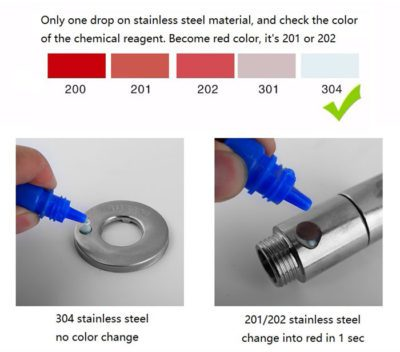
The grade confusion is real in our industry. I've seen suppliers claim "stainless steel" without specifying the grade, then use the cheapest option available. 201 grade steel costs about 30% less than 304, but it contains less chromium and nickel. In kitchen use, this means faster corrosion, especially with dishwasher salts and food acids. When customers pay premium prices for "stainless steel" colanders, they expect them to stay shiny and rust-free for years.
For importers and private label buyers, specifying 304 grade (18/8 stainless) gives much better customer satisfaction. The cost difference is usually $0.50-1.00 per unit, but it prevents rust complaints and supports higher retail prices. Clear grade marking also helps with regulatory compliance in markets that require material disclosure.
Steel grade affects more than just corrosion resistance. 304 steel has better formability, which allows for smoother curves and better-formed handles. It also takes a better polish and maintains its appearance longer. The nickel content in 304 gives it a warmer color and feel compared to the grayer appearance of 200-series steels.
Market positioning depends heavily on steel grade disclosure. Retailers who can advertise "18/8 stainless steel" or "304 grade" command higher prices than those selling generic "stainless steel" products. The certification documentation also matters for export compliance and quality assurance programs.
Over our 29 years in the business, we've seen quality expectations rise consistently. What passed for acceptable stainless steel quality 20 years ago won't satisfy today's consumers. This trend will continue as customers become more educated about materials and manufacturing quality.
How Does Inoxicon Address These Five Critical Issues?
At Inoxicon, we've learned from 29 years of customer feedback. These five details make the difference between satisfied customers and complaint letters.
Our quality control focuses on reinforced welding, proper hole sizing, mirror polishing, stable bases, and 304-grade steel. These specifications prevent most common problems and support premium positioning in retail markets.
Every colander we make goes through specific tests for these five areas. Handle strength testing with 20-pound loads, hole size verification, surface roughness measurement, stability testing with real food loads, and steel grade certification. It takes more time and costs more than basic manufacturing, but it prevents the problems that create expensive warranty claims and damage brand reputations.
Our approach combines engineering precision with real-world testing. We don't just check dimensions - we test products the way customers actually use them. This includes dishwasher cycling, thermal shock testing, and long-term corrosion exposure. The extra testing catches problems that don't show up in basic quality control but cause complaints months after purchase.
Conclusion
Small manufacturing details create big customer problems. Focus on these five areas to build colanders people actually want to buy again.