
A low quotation may hide outsourced processes, substituted materials, weak engineering control, or unrealistic capacity. These problems usually appear only after sampling or production begins.
Choose a kitchen utensil manufacturer by verifying product-specific processes, material traceability, engineering control, MOQ logic, mass-production standards, available capacity, and packaging execution. The key is not whether the supplier looks large, but whether it can control your exact product from raw material to shipment.
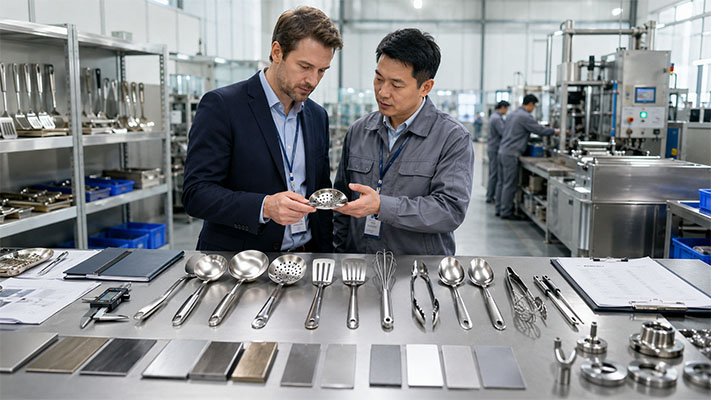
The evaluation should follow the actual manufacturing route of the utensil. This reveals more than a catalog, certificate list, or general factory presentation.
Does the Factory’s Production Setup Match Your Product?
A supplier may produce stainless steel ladles well but struggle with wire whisks, silicone overmolding, coated nylon tools, or mixed-material utensil sets.
Map each product to its critical processes, then verify who controls those processes. Relevant operations may include stamping, deep drawing, wire forming, welding, polishing, injection molding, overmolding, wood processing, coating, assembly, and logo application.
For example, a stainless steel turner with a silicone handle may involve:
- Stainless steel sheet sourcing
- Metal blanking and forming
- Edge finishing
- Handle insert production
- Silicone molding
- Metal-to-handle assembly
- Logo application
- Final inspection
The manufacturer does not need to complete every process in-house. However, it should explain which steps are outsourced and how purchased parts are controlled.
Ask for evidence connected to similar products:
- Production videos showing the relevant process
- Current work-in-progress samples
- Equipment used for forming, welding, polishing, or molding
- Incoming inspection records for outsourced components
- Batch identification for metal, silicone, nylon, or coatings
- A process flow chart for the proposed product
A supplier claiming to manufacture stainless steel, silicone, nylon, wood, and coated utensils should be able to identify where each material is processed. If the explanation remains unclear, the supplier may only be coordinating finished products from several sources.
That creates additional risks in color consistency, assembly fit, lead time, and responsibility when a component fails.
Do the Material Documents Match the Actual Utensil?
“Food-grade stainless steel” and “food-grade silicone” are descriptions, not complete material specifications.
Verify the material grade, thickness, formulation, color, coating, and supplier for every food-contact component. Test reports should match the proposed material and product structure rather than simply showing that the factory once tested a similar item.
A stainless steel utensil specification should state more than “304 stainless steel.” It should also confirm:
- Which parts use SS304
- Material thickness
- Whether handles contain other grades
- Whether welding materials are different
- Surface finish requirements
- Whether any coating or printed area contacts food
The same principle applies to silicone, nylon, and plastic. A report for one silicone formulation may not cover another hardness, pigment, or supplier. Custom colors can introduce new pigment systems that require separate confirmation.
Compare each test report against six questions:
| Checkpoint | What to Verify |
|---|---|
| Material | Same grade or formulation |
| Color | Same pigment or color system |
| Structure | Same food-contact components |
| Use condition | Relevant temperature and food type |
| Market | Applicable standard and test method |
| Identity | Traceable supplier and tested sample |
A general factory audit or management certificate does not prove product compliance. The useful documents are the bill of materials, raw-material specifications, supplier declarations, batch records, and reports related to the actual private-label version.
When several materials are combined in one product, each food-contact part should be reviewed separately.
Can the Manufacturer Control Structural Changes and Tooling?
A supplier’s engineering ability becomes clear when a requested design cannot be produced exactly as drawn.
A capable custom kitchen utensil manufacturer should identify forming, strength, assembly, and tooling risks before opening a mold. It should record each change in versioned drawings and convert the approved design into controlled production documents.
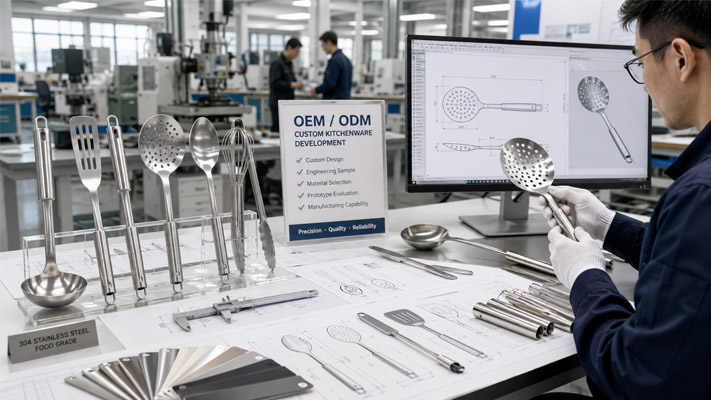
Consider a silicone spatula with an internal metal core. Small design changes can affect:
- The stiffness of the spatula head
- The bond between silicone and metal
- The risk of the core becoming exposed
- Handle balance
- Mold filling
- Product cooling time
- Production output per mold
A useful engineering review should explain these consequences. Simply confirming “we can make it” is not enough.
The sampling process should normally move through three controlled stages:
Functional Engineering Sample
This sample confirms material, dimensions, balance, strength, and basic performance. It may not use final packaging or final surface details.
Pre-Production Sample
This sample should use the intended material suppliers, production process, logo method, finish, color, and packaging structure.
Golden Sample
The final signed sample becomes the physical reference for production and inspection. It should correspond to the approved drawing and bill of materials.
For new tooling, confirm mold ownership, storage location, cavity count, expected output, maintenance responsibility, and modification costs. These terms should be written before the tooling payment is made.
Also ask how design revisions are recorded. If dimensions and structural changes exist only in emails or chat messages, an older version may accidentally enter production.
Does the MOQ Reflect the Real Production Setup?
A single MOQ can hide separate minimum quantities for materials, colors, components, logos, and packaging.
The correct MOQ should be traced back to its production driver. Existing items with laser logos may support lower quantities. Custom colors, molded handles, exclusive components, printed boxes, and new tooling normally create separate batch requirements.
| Customization | Main MOQ Driver |
|---|---|
| Laser logo on an existing utensil | Logo and production setup |
| Custom silicone color | Silicone and pigment batch |
| Special stainless steel thickness | Raw-material purchase quantity |
| Modified molded handle | Tooling and molding setup |
| Printed retail box | Packaging printer minimum |
| New product structure | Mold cost and economic production run |
This breakdown helps identify whether the proposed MOQ is technically reasonable.
For a 12-piece utensil set, the highest component MOQ may determine the total order quantity. If eleven components are existing products but one handle requires a custom silicone color, that handle may control the MOQ for the entire set.
Ask whether the same material or color can be shared across several SKUs. A common silicone formulation, handle structure, logo method, or packaging style can reduce setup complexity.
Also separate the first-order MOQ from the reorder MOQ. The first order may include tooling, color development, and packaging printing. Reorders can be more flexible if the same materials and packaging remain available.
How Will the Approved Sample Become a Production Standard?
Sample approval alone does not prevent thinner material, weaker welds, inconsistent polishing, or substituted components.
Convert the approved sample into measurable specifications covering material, thickness, weight, dimensions, tolerances, surface finish, color, joint strength, logo position, and packaging. Production inspection should compare the batch against these records and the signed golden sample.
The inspection plan should focus on product-specific failure risks.
For stamped stainless steel utensils, check:
- Material thickness after forming
- Edge smoothness
- Flatness and symmetry
- Surface scratches
- Polishing consistency
- Handle alignment
For wire whisks and mesh products, check:
- Wire diameter
- Wire quantity and spacing
- Weld or fixing strength
- Shape recovery
- Loose wire risk
- Joint cleanliness
For silicone or nylon utensils, check:
- Color difference
- Odor
- Hardness
- Flash and trimming
- Deformation
- Handle pull strength
- Heat-performance requirements
Terms such as “strong handle” should be replaced with an agreed pull, torque, bending, or use-cycle test. “Good polishing” should be supported by an approved finish sample and defined inspection conditions.
Written approval should be required before changing material grades, suppliers, formulations, components, production processes, or packaging. This is especially important when a product passes testing using one material source.
INOXICON can review the manufacturing and inspection requirements for stainless steel utensils, mixed-material products, and custom utensil sets before sample development.
Is the Quoted Lead Time Based on Available Capacity?
Factories often quote lead time from theoretical production capacity. Actual delivery depends on the slowest process and the capacity already committed to other orders.
Ask for the output and available capacity of the project’s bottleneck process. For kitchen utensils, this may be manual polishing, welding, silicone molding, assembly, inspection, or retail packaging rather than metal stamping.
A factory may stamp 30,000 metal blanks per day but polish only 8,000 finished pieces. The lower number determines the practical output.
Mixed-material sets create another problem. Metal parts may be ready while molded handles, wooden components, or printed boxes are delayed by external suppliers.
Request a schedule that separates:
- Material preparation
- Tooling or mold development
- Metal forming or molding
- Polishing and surface treatment
- Assembly
- Product testing
- Packaging production
- Final inspection
- Container loading
Ask which machines, molds, or production lines will be allocated to the order. The schedule should also show when outsourced components must arrive.
First orders usually require more time because they include sample revisions, testing, artwork approval, and packaging trials. Repeat-order lead time should be discussed separately.
Can the Packaging Be Verified Before Mass Production?
A packaging drawing may look correct while the actual set is difficult to assemble, poorly protected, or inefficient to load.
Complete a physical packaging trial before printing the full quantity. The trial should confirm product arrangement, surface protection, box strength, barcode accuracy, assembly time, master-carton dimensions, and the final number of units that can be loaded into a container.
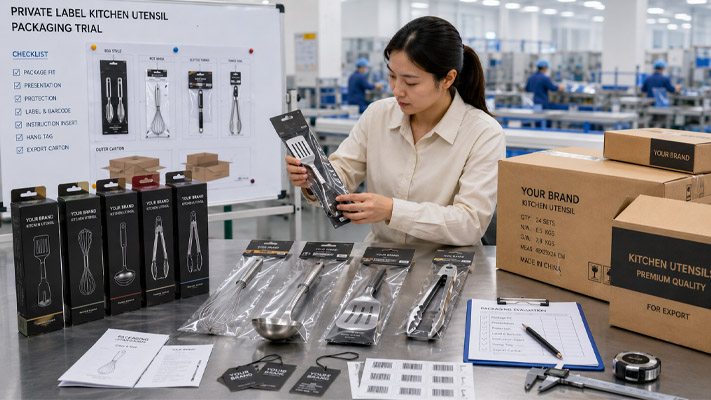
This step is especially important for utensil sets. Different handle lengths, product weights, and polished surfaces can create movement inside the box.
A packaging trial should answer:
- Do the utensils stay in position during transport?
- Can metal parts scratch each other?
- Does the insert hold heavier utensils securely?
- Can the set be packed efficiently on the production line?
- Do the carton dimensions match the quoted freight calculation?
- Can mixed SKUs be identified correctly during loading?
Confirm the units per carton, carton dimensions, gross weight, carton volume, pallet arrangement, and estimated container quantity before production.
Even a small carton-size reduction can improve container utilization across a large order. Packaging development should therefore be treated as part of product engineering, not as a final decoration step.
What Evidence Should Decide the Final Selection?
The strongest supplier is not necessarily the one with the largest catalog or lowest quotation. It is the one that can connect every promise to the proposed product.
Give priority to evidence covering process ownership, material identity, engineering control, measurable production standards, available bottleneck capacity, and completed packaging trials. Price should be compared only after these critical requirements have been verified.
Before confirming a kitchen utensil manufacturer, make sure the supplier can provide:
- A production route for each product
- Disclosure of outsourced processes
- A product-specific bill of materials
- Relevant material and test documents
- Controlled drawings and sample versions
- Written golden-sample standards
- A realistic capacity and production schedule
- Verified retail and shipping packaging
A quotation without material thickness, finish, logo method, packaging structure, and inspection requirements cannot be compared accurately.
The objective is not to find a factory that says yes to every request. It is to find one that can explain how the product will be made, where the risks are, how the batch will be controlled, and what evidence will support each decision.
Conclusion
Select a manufacturer through product-specific evidence. Process control, material traceability, engineering records, batch standards, available capacity, and packaging trials determine whether a private-label project can scale reliably.
Request a Private Label Feasibility Review
Send INOXICON your product list, materials, expected quantities, destination market, and packaging requirements. Our team will review the required processes, customization risks, estimated MOQ, and sample-development plan.