
Sourcing bakeware seems straightforward, but hidden compliance risks can derail your business. Your brand reputation and market access depend on getting it right from the start.
To source bakeware effectively, you must understand food contact regulations like LFGB and FDA. These standards dictate material safety, affecting your choice of supplier, production costs, and lead times. Choosing a manufacturer who already meets these standards is the key to a smooth and successful import process.
When you import bakeware, you're not just buying a product; you're buying a promise of safety for your customers. For over 28 years, I've seen how these regulations shape the entire kitchenware industry. Many buyers, especially those new to the field, underestimate how much these rules impact their business. They focus on price and design, which are important, but they forget about compliance. This can lead to big problems later, like rejected shipments or legal trouble. Understanding these rules is the first step to building a strong and trusted brand. Let's look at what these regulations mean for you.
What's the real difference between FDA and LFGB for bakeware?
Confused about whether to choose FDA or LFGB compliance? This decision affects your costs, market access, and brand reputation. Making the wrong choice can limit your sales or lead to costly re-testing.
LFGB is generally stricter than FDA, with more thorough testing for chemicals and sensory impact. An LFGB-compliant product usually meets FDA standards too, giving you access to both European and American markets. This makes it a smart choice for global brands sourcing stainless steel bakeware.
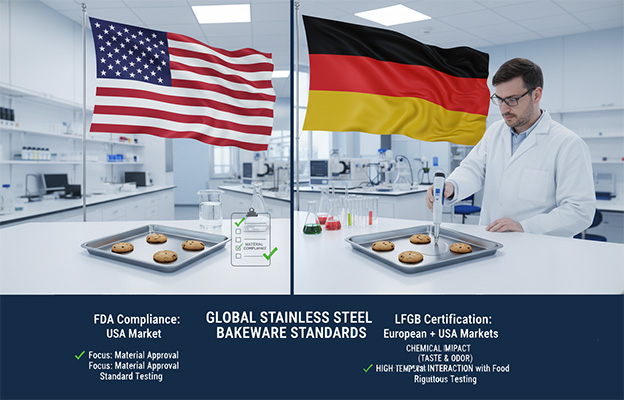
At our factory, we handle requests for both FDA and LFGB compliance all the time. The main difference is the level of detail in the testing. Think of it like this: the FDA sets the rules for what materials can be used, while the LFGB goes a step further to test how those materials behave when they touch food. For bakeware, this is very important because of the high temperatures involved.
Understanding FDA Requirements
The U.S. Food and Drug Administration (FDA) has a list of materials that are "Generally Recognized as Safe" (GRAS). For stainless steel bakeware, this usually means using approved grades like 304 (also known as 18/8) or 430. The FDA's focus is on the composition of the material itself. A manufacturer must prove that the steel they use meets these standards. It's a clear, chemistry-based approach.
Understanding LFGB Requirements
The German Food and Feed Code (LFGB) is the European standard and is known for being much stricter. It includes all the chemical requirements of the EU, but adds its own tests. The most famous one is the sensory test. A product cannot transfer any smell or taste to the food. It also has much lower limits for heavy metals like lead and cadmium migrating into food. An LFGB certificate is a strong signal of high quality and safety.
Here is a simple table to show the differences:
| Feature | FDA (U.S. Standard) | LFGB (German/EU Standard) |
|---|---|---|
| Main Focus | Material composition (Is the material safe?) | Material behavior (Does it affect the food?) |
| Testing Scope | Specific migration tests for known substances. | Comprehensive migration tests for a wider range of substances. |
| Unique Test | No sensory test required. | Mandatory sensory test (no taste or smell transfer). |
| Metal Limits | Sets limits for lead and cadmium. | Sets much stricter limits for heavy metals. |
| Market Access | USA | European Union and often accepted globally as a higher standard. |
For a client in North America who was planning to expand to Europe, we recommended getting LFGB certification from the beginning. It cost a little more upfront, but it saved them the headache and expense of re-certifying their entire bakeware line later. They were able to use one product for both markets, which simplified their inventory and sourcing.
How does compliance testing affect your sourcing costs and lead times?
Worried that compliance testing will blow your budget and delay your shipments? Unexpected testing fees and production holds can cause major problems for your import business, hurting your profits and timeline.
Compliance testing adds direct costs for lab reports and indirect costs from potential production delays. A good manufacturing partner plans for this. They will integrate testing into the production schedule, which prevents delays and ensures your bakeware is certified before shipment, saving you time and money.
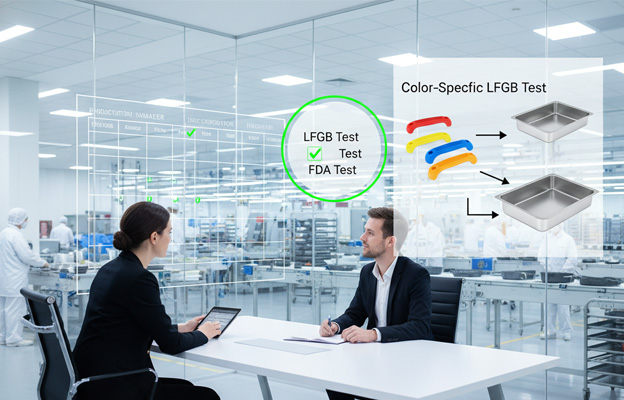
I remember a project with a new client who wanted a custom-colored silicone handle on their stainless steel baking pans. They were on a very tight schedule. What they didn't realize was that every single color needs its own LFGB test. This is a common point of confusion. It’s not just the material, but every component and color that comes into contact with food. Planning for this is a big part of what we do. The costs are not just about the test itself; they are also about the time it takes.
The Direct Costs of Testing
Lab testing is the most obvious expense. The price can change based on a few things:
- The Standard: LFGB testing is almost always more expensive than FDA testing because it is more detailed.
- The Material: Different materials require different tests. A product with multiple materials, like a stainless steel pan with a silicone handle, needs separate tests for both.
- The Number of Colors: As I mentioned, each color in a food-contact part needs its own certification. If you have five different handle colors, that means five separate lab tests.
These costs can add up quickly, especially for a large product line. A reliable supplier should give you a clear breakdown of these costs from the start.
The Hidden Costs: Time and Delays
The biggest impact is often on your lead time. Here’s how it can cause delays:
- Sample Preparation: We have to produce finished samples to send to the lab. This can take a few days.
- Testing Itself: A full LFGB test can take 1 to 2 weeks. If a test fails, we have to figure out why, fix the problem, and then test it all over again.
- Production Holds: You cannot start mass production until you have a passing test report. If you do, you risk having to scrap the entire order if it fails.
A good partner helps you manage this. For example, we often start the testing process during the pre-production sample stage. This way, by the time you approve the final sample, we already have the compliance certificate. This means we can start mass production immediately without any delays. This simple step can save you weeks on your delivery time. For our clients, this predictability is just as valuable as a good price.
Which bakeware materials are the easiest to get certified?
Choosing the right material for your bakeware is a huge decision. You might worry that your choice will complicate certification, increase costs, and delay your entry into the market.
Stainless steel, especially grade 304 (18/8), is one of the easiest and most reliable materials for passing both FDA and LFGB tests. It is stable, non-reactive, and does not contain harmful chemicals that can leach into food, making it a safe and dependable choice for high-quality bakeware.
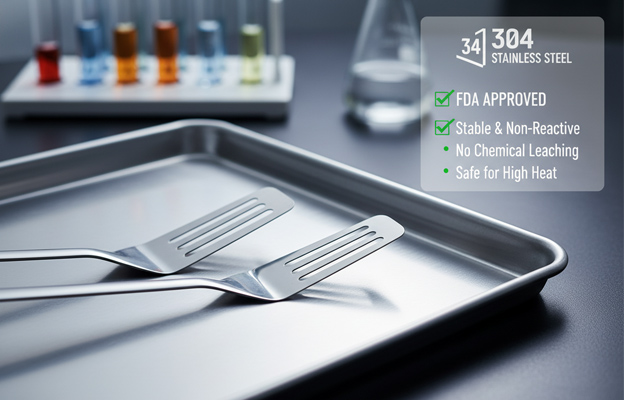
Over my 28 years in this business, I have worked with all kinds of materials. But when it comes to a balance of safety, durability, and ease of certification, stainless steel is always at the top of my list. We specialize in stainless steel for a reason. Its properties make it ideal for food contact, especially in high-heat applications like baking.
Why Stainless Steel is a Top Choice
Stainless steel's biggest advantage is its stability. Here’s why it consistently passes compliance tests:
- Inert Nature: High-quality stainless steel, like grade 304, is very non-reactive. It doesn't corrode or rust easily, and it doesn't react with acidic or alkaline foods. This means there is a very low risk of any metal particles migrating into the food.
- No Coatings Needed: Unlike other metals that may require a non-stick coating, stainless steel can be used as is. This simplifies the testing process because you are only testing one material. Coatings, on the other hand, add another layer of complexity and another potential point of failure in testing.
- Proven Track Record: Stainless steel has been used in kitchens for decades. Regulators like the FDA and LFGB have a lot of data on it, and it is widely accepted as a safe material.
Comparing Common Bakeware Materials
Let's look at how stainless steel compares to other popular materials when it comes to certification:
| Material | Pros for Certification | Cons for Certification |
|---|---|---|
| Stainless Steel (304) | Highly stable, non-reactive, no coating needed. Passes tests easily. | Quality can vary. Must use a good grade from a reliable supplier. |
| Silicone | Flexible and versatile. Generally safe when made from pure, food-grade material. | Cheap fillers can be used, which release harmful substances. Requires strict testing. |
| Aluminum | Lightweight and conducts heat well. | Can react with acidic foods. Often requires an anodized or non-stick coating, which needs its own testing. |
| Carbon Steel | Heats evenly and is very durable. | Prone to rust. It must be "seasoned" with oil or have a food-safe coating, adding complexity to testing. |
A few years ago, we helped a customer switch their bakeware line from coated aluminum to stainless steel. They were tired of dealing with customer complaints about scratched coatings and the recurring costs of testing the coatings. By moving to pure 304 stainless steel, they simplified their compliance process, reduced long-term costs, and were able to market their products as more durable and "healthier." It was a huge win for their brand.
How can you verify a supplier's compliance claims?
You found a supplier who claims their bakeware is FDA or LFGB compliant, but how do you know they are telling the truth? Placing an order based on a false claim can lead to seized goods and legal trouble.
Always ask for a copy of the full, unedited test report from an accredited third-party lab. Check that the report is recent, matches the exact product you are buying, and is issued in the supplier's name. Do not accept a supplier's internal declaration as proof.
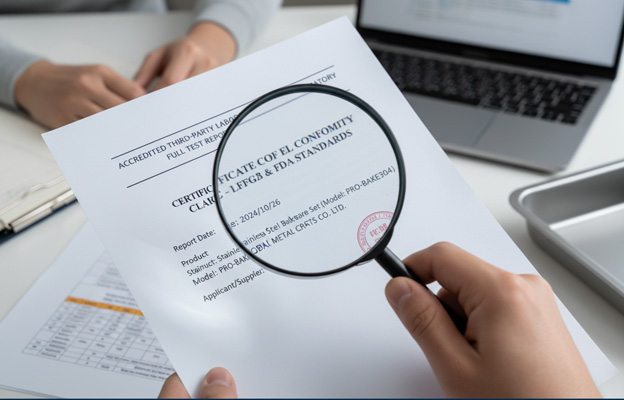
Trust is important in this business, but you should always verify. I've seen too many buyers get into trouble because they took a supplier's word for it. A professional manufacturer will not hesitate to provide proof of their compliance. In fact, we are proud of our certifications because they show our commitment to quality. If a supplier is hesitant or makes excuses, that is a major red flag.
Steps to Verify a Test Report
A test report contains a lot of information, and you need to know what to look for. Here is a simple checklist I give to all my new partners:
- Check the Lab's Name: Is the report from a well-known, accredited laboratory? Examples include SGS, TÜV, Intertek, or BV (Bureau Veritas). A report from an unknown lab might not be credible.
- Check the Applicant's Name: Does the company name on the report match your supplier's legal name? Some factories use reports from their material suppliers. This is not enough. The final product manufacturer should be the one holding the certificate for the finished product.
- Check the Product Description: Does the photo and description on the report exactly match the product you are ordering? A report for a "stainless steel bowl" is not valid for a "stainless steel baking tray with silicone handles." It must be specific.
- Check the Report Date: Regulations and material formulas can change. A report that is more than two or three years old might be out of date. We recommend our clients ask for reports that are less than two years old.
- Review the Conclusion: Look for the final verdict in the report. It should clearly state "Pass." Don't just look at the first page; scroll to the summary table or conclusion section.
A Story of Due Diligence
We once had a potential client come to us after a bad experience. Their previous supplier gave them an LFGB report that looked legitimate. But when their shipment arrived in Germany, it was stopped and tested by customs. The products failed. It turned out the supplier had given them an old report for a slightly different product. The client lost the entire shipment and faced a fine.
When they came to us, the first thing we did was walk them through our test reports for the exact products they needed. We showed them the lab name, the date, and the product details. This transparency is what builds long-term partnerships. Don't be afraid to ask detailed questions. A good supplier will have the answers and the proof to back them up.
What happens if your bakeware fails a compliance test?
Your production is underway, and you just received bad news: your bakeware failed its LFGB or FDA compliance test. Now you're facing a crisis with potential financial losses and major delays.
If a test fails, you must stop production immediately. The supplier needs to identify the root cause—was it a bad batch of raw material or a contamination issue? Then, they must correct the problem and re-submit the product for a new test before production can resume.
A test failure is a serious problem, but it doesn't have to be a disaster if your supplier knows how to handle it. The key is a quick and systematic response. Panicking or trying to hide the problem only makes things worse. Over the years, we've had to deal with this, and having a clear process is everything. Most failures happen with suppliers who try to cut corners on raw materials.
The Root Cause Analysis
The first step is always to find out why the test failed. This is a critical diagnostic process. A good manufacturer will not just guess; they will investigate.
- Material Contamination: The most common reason is a bad batch of raw materials. For example, a supplier of stainless steel might have provided a lower-grade alloy that contains higher levels of impurities than allowed. Or, for a product with silicone parts, the silicone may have been mixed with cheap fillers.
- Cross-Contamination in the Factory: Sometimes, the problem happens during production. For instance, if the same machinery is used for different types of metals without proper cleaning, particles can cross-contaminate the bakeware.
- Incorrect Production Parameters: For materials like silicone, the curing time and temperature are very important. If not done correctly, chemicals can remain that will leach out during testing.
We had a case once where a silicone handle for a baking dish failed an LFGB test. We immediately stopped the line and sent our raw material batch to the lab for analysis. At the same time, our engineers reviewed the production records. It turned out the vulcanizing agent (a chemical used for curing) was from a new supplier and was not as pure as our usual one. We immediately quarantined the faulty material, sourced from our trusted original supplier, and produced new samples.
The Correction and Re-testing Process
Once the cause is found, the next steps are clear:
- Correct the Issue: This might mean rejecting a whole batch of raw materials and ordering new ones, or it could mean changing a production process.
- Produce New Samples: New test samples must be made using the corrected materials or process.
- Re-test: These new samples are sent back to the lab for a full re-test. This adds cost and time, but it is absolutely necessary. You cannot move forward without a passing certificate.
This process highlights why working with an experienced manufacturer is so important. A cheap, inexperienced factory might not know how to diagnose the problem, or they might try to argue with the lab results. A professional partner takes responsibility, solves the problem efficiently, and communicates with you every step of the way. This is how you turn a potential crisis into a resolved issue.
Conclusion
Understanding FDA and LFGB rules is essential for sourcing safe, compliant bakeware. It impacts your costs, timelines, and market access, making your choice of manufacturer critically important.