
Many sellers choose the cheapest utensil first. Then Amazon fees, ads, and coupons reduce the margin faster than expected.
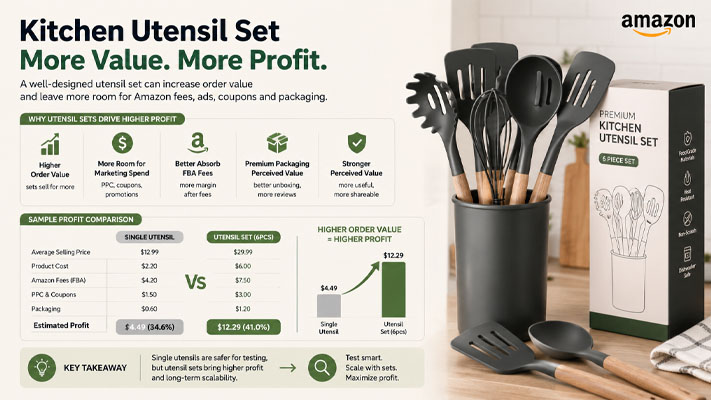
A well-designed utensil set usually has better Amazon profit because it raises order value and gives more room for FBA fees, PPC, coupons, and packaging. A single utensil is safer for testing, but it needs clear differentiation or a multipack strategy.
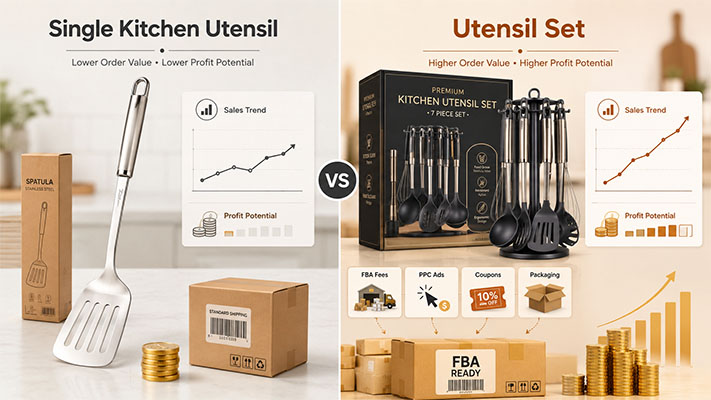
I do not judge this question by factory price alone. A single spatula may cost less to buy, but that does not mean it earns more. A utensil set may cost more to produce, but it can also sell at a higher price. On Amazon, profit depends on the full cost chain. I need to look at product cost, packaging, freight, referral fee, FBA fee, PPC, coupons, and return risk before I decide which model is better.
Why Is Kitchen Utensil Profit Hard to Judge on Amazon?
A kitchen utensil looks simple. But the real profit can disappear after Amazon fees, shipping, ads, and returns.
Kitchen utensil profit is hard to judge because factory cost is only one part of the calculation. I must compare landed cost, Amazon fees, FBA cost, PPC cost, packaging, and final selling price before I know the real margin.
The full cost matters more than the factory cost
I often see sellers compare a single utensil and a utensil set by factory price. This is too simple. A single utensil may have a low unit cost, but it usually has a low selling price too. When the retail price is low, every fixed cost becomes painful. Amazon referral fees, fulfillment fees, inbound freight, PPC, and coupons can take a large share of the order.
A utensil set has a higher production cost, but it also has a higher selling price. This gives the seller more space to absorb fees and still keep profit. That does not mean every set is good. A large set with weak pieces can cause bad reviews and returns. But a focused set with useful tools can create stronger unit economics.
| Factor | Single Utensil | Utensil Set |
|---|---|---|
| Factory cost | Lower | Higher |
| Selling price | Lower | Higher |
| FBA fee pressure | Higher as a percentage | Easier to absorb |
| PPC pressure | Harder to carry | Easier to carry |
| Inventory risk | Lower | Higher |
| Profit per order | Usually lower | Usually higher |
At INOXICON, I usually suggest buyers compare both models with a full landed-cost sheet before they confirm the product structure.
Does a Single Kitchen Utensil Have Better Profit?
A single utensil feels safe because the cost is low. But a basic item can quickly become a price-war product.
A single kitchen utensil can be profitable when it solves a clear problem, uses better material, or sells as a 2-pack or 3-pack. A plain low-price utensil often struggles because Amazon fees and PPC take too much margin.
A single utensil must have a reason to exist
I do not reject single utensils. Some single tools sell well because they serve a clear need. A fish spatula, spider strainer, dough whisk, wok spatula, silicone turner, or stainless steel tong can target a very specific buyer. These products can work because the customer is not only looking for “a cheap utensil.” The customer is looking for a tool that solves one cooking problem.
But I would avoid launching a very basic spatula with no clear difference. It is easy to copy. It is easy to compare. The seller may have to lower the price or use coupons to get orders. That weakens profit.
A single utensil works better when it has one strong selling point. It can use 304 stainless steel. It can have a seamless silicone head. It can be safe for nonstick cookware. It can have a stronger handle. It can also be sold as a 2-pack to raise the order value.
| Single Utensil Strategy | Why It Helps Profit |
|---|---|
| Specialty tool | Less direct competition |
| Premium material | Supports a higher price |
| 2-pack or 3-pack | Raises order value |
| Better handle design | Creates visible value |
| Niche keyword focus | Makes ads more precise |
For me, a single utensil is best as a test product, add-on product, or niche product. It is not always the best hero product for long-term Amazon profit.
Does a Kitchen Utensil Set Have Better Profit?
A utensil set costs more at the beginning. But it can also carry a higher selling price and better value perception.
A kitchen utensil set usually has better absolute profit because it increases average order value. It gives the seller more room for Amazon fees, ads, packaging, coupons, and branding while keeping a healthier profit per order.
A focused set is better than a large filler set
A utensil set sells convenience. The customer can buy several daily-use tools in one order. This is useful for new homes, apartments, gift buyers, and people replacing old kitchen tools. A set also looks stronger in the main image. On Amazon, this matters because the customer makes quick decisions.
A set can also rank for broader search terms, such as “kitchen utensil set,” “silicone cooking utensils,” “stainless steel utensil set,” or “nonstick cookware utensils.” This gives the listing more room to grow.
But I do not think a bigger set is always better. Some 30-piece sets include too many low-value pieces. The number looks attractive, but the customer may feel disappointed after opening the box. That can lead to weak reviews.
I prefer a set with fewer but better pieces. A 7-piece, 9-piece, 10-piece, or 12-piece set can be easier to control. It can also feel more premium if every tool has real use.
| Set Type | Profit Potential | Main Risk |
|---|---|---|
| 5-piece starter set | Medium | Lower perceived value |
| 7-piece stainless steel set | High | Needs good finish |
| 10-piece silicone set | High | Needs material trust |
| 12-piece daily-use set | High | Must avoid filler pieces |
| 30-piece value set | High volume | More return and quality risk |
When I design an OEM or ODM utensil set at INOXICON, I prefer useful pieces, compact packaging, and a clear material story over a high piece count.
How Do FBA Fees and PPC Change the Result?
A product may look profitable before launch. Then ads start running, and the real margin becomes clear.
FBA fees and PPC usually favor utensil sets because sets have higher order value. A low-price single utensil can lose profit quickly when ads, coupons, and fulfillment costs are added.
Higher order value gives more breathing room
I always look at profit after advertising. This is important because most new Amazon listings need PPC at the beginning. A new product has few reviews. It has weak organic ranking. It needs paid traffic to get visibility.
This is where single utensils become difficult. If a utensil sells at a low price, the seller has little room for ads. Even a small PPC cost per order can damage the profit. A coupon can make the margin thinner. If the product also needs better packaging or faster freight, the profit may disappear.
A utensil set has more breathing room because the selling price is higher. The seller can spend more to acquire a customer and still keep profit. The set can also support a better main image, better packaging, and stronger brand content. These things may improve conversion rate. A better conversion rate can make PPC more efficient.
| Cost Area | Single Utensil | Utensil Set |
|---|---|---|
| PPC tolerance | Low | Higher |
| Coupon tolerance | Low | Higher |
| Branding space | Limited | Stronger |
| Main image impact | Smaller | Stronger |
| Break-even control | Harder | Easier if cost is controlled |
This is why I usually see better profit potential in a well-planned utensil set. The set gives the seller more room to make Amazon work.
When Should a Seller Choose a Single Utensil Instead?
A utensil set is not always the right answer. A single tool can win when the market need is narrow and clear.
A seller should choose a single utensil when the product targets a specific cooking task, tests a new market, or supports an existing product line. It works best when the design is not generic.
Single tools work well for testing and niche demand
I would choose a single utensil when I want to test demand with lower inventory risk. This is useful for new shapes, new materials, new colors, or new cooking trends. A seller can test one stainless steel skimmer before building a full stainless steel utensil line. A seller can test one silicone spatula before creating a full silicone set.
A single utensil also works when the keyword is very specific. For example, “fish spatula,” “spider strainer,” “wok spatula,” and “dough whisk” are not the same as broad “kitchen utensil.” The buyer often knows what they need. That makes the product easier to position.
A single tool can also support a hero set. If a seller already has a utensil set, matching single tools can become replacement items or bundle items. This gives the brand more depth without creating a completely new category.
| Best Use for Single Utensil | Reason |
|---|---|
| Market testing | Lower cash risk |
| Niche keyword targeting | Clearer buyer intent |
| Multipack selling | Better order value |
| Replacement item | Supports existing buyers |
| Add-on SKU | Builds product line depth |
So I do not see single utensils as weak products. I see them as sharp products. They need clear purpose, clear design, and clear pricing.
What Is the Best Amazon Strategy for Higher Profit?
The best answer is not always one product or the other. A smart product line can use both.
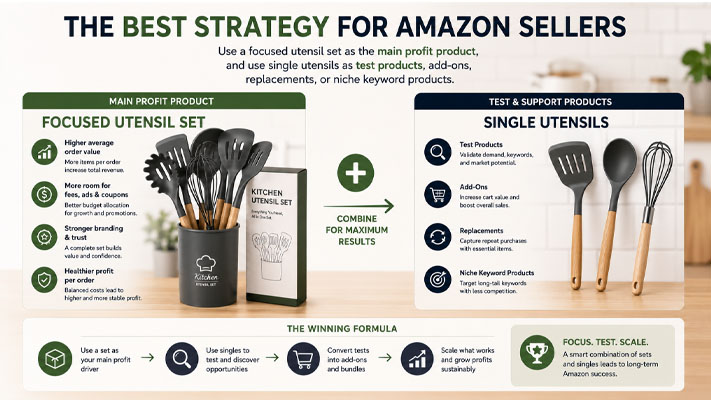
For most Amazon sellers, the best strategy is to use a focused utensil set as the main profit product and use single utensils as test products, add-ons, replacements, or niche keyword products.
I prefer a hero set with matching single tools
If I were building this category, I would start with a focused utensil set. I would not start with the biggest set. I would choose a set that has useful pieces, a clean design, controlled weight, compact packaging, and a selling price with enough room for Amazon costs.
A 7-piece, 9-piece, or 10-piece set can be a good balance. It is easier to explain than a single tool. It is less risky than a large 30-piece set. It can still create a higher order value and better profit per sale.
Then I would add single utensils that match the set. These single tools can help test keywords, support replacement demand, and create bundle options. They can also give the brand more space in the Amazon store.
| Product Role | Suggested Product | Purpose |
|---|---|---|
| Hero product | 7-piece to 10-piece utensil set | Main profit |
| Test product | Specialty single utensil | Keyword testing |
| Add-on product | 2-pack tool | Higher order value |
| Premium product | Stainless steel set | Better margin |
| Replacement product | Matching single tool | Repeat purchase |
This strategy gives me both profit and flexibility. The set creates stronger revenue per order. The single tools help me learn the market and grow the line step by step. If you are comparing both options for a private label line, INOXICON can help adjust the set structure, material, MOQ, and packaging before production.
Conclusion
I prefer a focused utensil set for Amazon profit, then I use single tools to test niches, support bundles, and grow the product line.