
Choosing cookware only by layer count can make a product look stronger on paper, but it can also raise cost, weight, and market risk.
3-ply stainless steel cookware is usually better for practical daily-use lines, lighter handling, and easier cost control. 5-ply stainless steel cookware is better for premium lines, stronger heat retention, and a higher-value product image. The right choice depends on price level, channel position, and cooking needs.
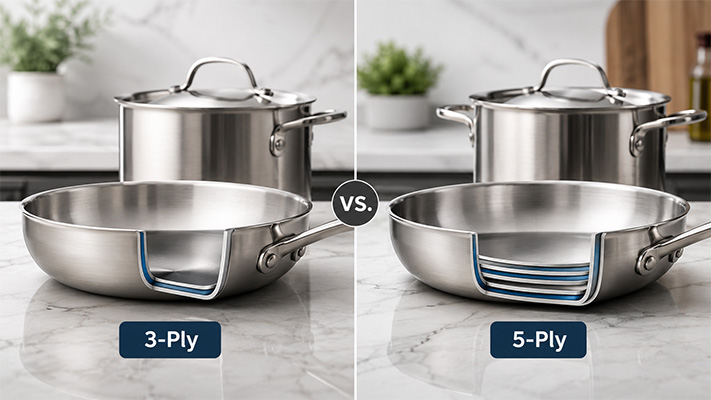
In stainless steel cookware development, more layers do not always mean a better product. A good cookware structure must match the full product plan. It must fit the target retail price, user habits, packaging level, and long-term product strategy. From years of stainless steel kitchenware manufacturing experience, one lesson is clear: the smartest structure is the one that helps the product sell clearly, perform reliably, and stay profitable over time.
What Does Ply Count Really Change in Stainless Steel Cookware?
Many product decisions become unclear when ply count is treated as a simple quality ranking. This can lead to expensive products that do not match the market.
Ply count changes heat transfer, heat retention, product weight, cost, hand feel, and selling position. It should be judged together with thickness, material grade, handle design, surface finish, packaging, and target price.
Why ply count is a product strategy decision
Stainless steel gives strength, corrosion resistance, and a clean cooking surface. Aluminum or copper is often added inside the cookware body because it spreads heat faster than stainless steel. The bonded structure decides how the cookware heats, how heavy it feels, and how much it costs to produce.
| Product Factor | What Ply Count Affects | Why It Matters |
|---|---|---|
| Heat transfer | How fast heat moves through the body | Affects daily cooking speed |
| Heat retention | How well the pan holds temperature | Affects searing and frying |
| Weight | How heavy the cookware feels | Affects user comfort |
| Cost | How much the body costs to make | Affects final price |
| Product image | How premium the item feels | Affects shelf value |
A 3-ply product can be very strong when the goal is daily cooking and wide customer acceptance. A 5-ply product can be very strong when the goal is premium cooking performance and a higher product image. The risk comes from choosing the structure before defining the product level. In a well-planned cookware line, ply count is not decoration. It is part of the price and value strategy.
When Does 3-Ply Stainless Steel Cookware Make More Business Sense?
3-ply cookware can sound less premium than 5-ply, but it often gives better balance for practical product lines. This is where many stable collections succeed.
3-ply stainless steel cookware makes more business sense when the product needs lighter handling, faster heating, easier pricing, and wider daily-use appeal.
Why 3-ply still works well in many product lines
3-ply stainless steel cookware usually uses a stainless steel inner layer, an aluminum core, and a stainless steel outer layer. This structure gives the pan a clean cooking surface, better heat movement, and a durable outside body. It does not add too much weight or cost, so it works well for daily cookware sets, frying pans, saucepans, stockpots, and sauté pans.
| Product Need | Why 3-Ply Can Be Better |
|---|---|
| Cost control | Easier to keep the final price friendly |
| Daily cooking | Good heating for common kitchen tasks |
| Lighter handling | Easier to lift, wash, and use often |
| Product testing | Lower starting risk for a new line |
| Wider appeal | Easier for customers to understand |
The main value of 3-ply is not that it is basic. The value is balance. Many users do not need heavy cookware for every meal. They need a pan that heats well, feels comfortable, cleans easily, and does not cost too much. From a manufacturing view, 3-ply is often the safer choice when a product line needs stable repeat sales, practical performance, and better price control.
When Is 5-Ply Stainless Steel Cookware Worth the Higher Cost?
5-ply cookware should not be chosen only because the number sounds stronger. It must create enough value to support the higher cost.
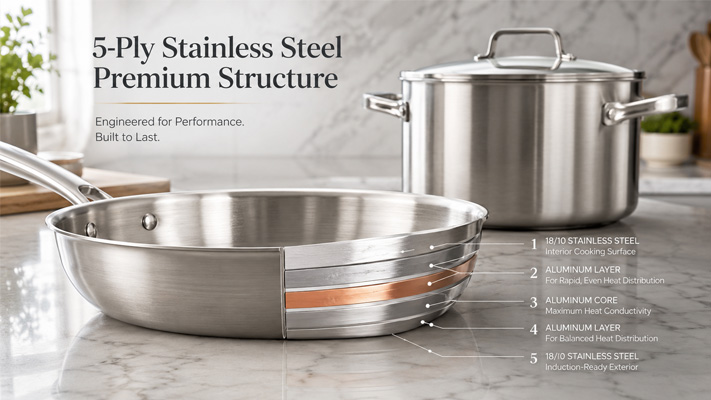
5-ply stainless steel cookware is worth the higher cost when the product needs stronger heat retention, heavier hand feel, premium positioning, and a more powerful product story.
Where 5-ply creates real value
5-ply cookware has five bonded metal layers. These extra layers can help the cookware hold heat more steadily. This can be useful for searing meat, frying at higher heat, and cooking dishes that need more stable temperature control. The heavier body also gives the product a stronger hand feel, which many customers connect with quality.
| Product Need | Why 5-Ply Can Be Better |
|---|---|
| Heat retention | Better for high-heat cooking |
| Premium feel | Heavier and more solid in hand |
| Higher price point | Supports a stronger value message |
| Gift-ready line | Works well with better packaging |
| Performance story | Easier to explain as an upgrade |
Yet 5-ply also needs careful planning. If the channel is price-sensitive, the higher cost may not bring enough return. If the product is too heavy, some users may not enjoy daily use. If the packaging looks simple, the premium story becomes weak. From years of product development work, 5-ply performs best when the whole product supports the higher level. The body, handle, lid, polishing, logo, and packaging must all match the same value position.
How Do 3-Ply and 5-Ply Compare in Cost, Weight, and Market Position?
The choice between 3-ply and 5-ply should not be based on one feature. It should be based on how the full product will compete.
3-ply is usually better for cost control, lighter handling, and daily-use ranges. 5-ply is usually better for premium value, stronger heat control, and upgraded collections.
A practical comparison for product planning
A cookware line needs a clear role for each structure. 3-ply can be the main practical series. It supports daily use, simple pricing, and broad customer needs. 5-ply can be the upgrade series. It supports higher perceived value and a stronger performance message.
| Point | 3-Ply Stainless Steel Cookware | 5-Ply Stainless Steel Cookware |
|---|---|---|
| Heating | Heats quickly | Heats steadily |
| Heat retention | Good for daily cooking | Stronger for high-heat cooking |
| Weight | Lighter and easier to handle | Heavier and more solid |
| Cost | Easier to control | Higher |
| User feel | Practical and comfortable | Premium and strong |
| Best use | Daily meals | Searing, frying, slow cooking |
| Product level | Mid-range and practical | Premium and performance-led |
| Risk | Lower cost pressure | Needs stronger price support |
A common mistake is using 5-ply for a product that must stay at a very competitive price. The product becomes expensive, but the customer may not pay enough for the extra layers. Another mistake is using 3-ply for a premium series that needs a stronger performance story. The product may work well, but it may not feel special enough. A clear product ladder can solve this problem. 3-ply can carry the main volume range, while 5-ply can create a higher-value upgrade.
Which Structure Fits Different Product Lines Better?
Every product line needs a clear role. A cookware structure should support that role, not make the line harder to explain.
3-ply fits daily cookware sets, value-focused collections, and lightweight practical designs. 5-ply fits premium cookware series, chef-style collections, gift-ready sets, and performance-focused products.
How to match structure with product direction
The right structure depends on the promise made to the customer. If the promise is easy daily cooking, then the cookware should feel light, useful, and price-friendly. If the promise is premium performance, then the cookware should feel solid, stable, and refined from the first touch.
| Product Direction | Better Structure | Main Reason |
|---|---|---|
| Daily cookware set | 3-ply | Practical and easy to use |
| Mid-range frying pan | 3-ply | Good heat with controlled cost |
| Family cooking line | 3-ply | Lighter and more comfortable |
| Premium saucepan series | 5-ply | Stronger product value |
| Chef-style frying pan | 5-ply | Better heat retention |
| Gift cookware set | 5-ply | Higher perceived value |
| Upgrade collection | 5-ply | Clear step-up from basic lines |
Product structure should also match design details. A 3-ply line should focus on clean design, stable quality, and strong value. A 5-ply line should use better polishing, stronger handles, refined lids, and more protective packaging. This creates a consistent product message. When every detail supports the same level, the product becomes easier to position and easier to explain.
What Should Be Checked Before Mass Production?
A good sample is only the start. Stable production depends on clear standards, repeated checks, and careful control of small details.
Before mass production, stainless steel grade, aluminum core thickness, body thickness, bottom flatness, handle strength, surface finish, lid fit, induction performance, packaging, and test standards should be checked.
Key checks that affect long-term product quality
Many cookware problems come from details that are easy to miss at the sample stage. The surface may look bright in photos but show uneven polishing under stronger light. The handle may look firm but feel loose after repeated use. The lid may fit one sample well but vary during production. The bottom may look flat but perform poorly on induction or ceramic stoves.
| Checkpoint | Why It Matters |
|---|---|
| Stainless steel grade | Affects safety, durability, and corrosion resistance |
| Aluminum core thickness | Affects heat transfer and cooking performance |
| Body thickness | Affects strength and product feel |
| Bottom flatness | Affects stove contact and heating stability |
| Handle strength | Affects safety during daily use |
| Riveting or welding | Affects durability and appearance |
| Surface finish | Affects shelf image and customer satisfaction |
| Lid fit | Affects cooking comfort |
| Packaging | Reduces damage during transport |
| Food-contact standard | Supports market compliance |
A clear approved sample is important before production starts. Drawings, material details, weight range, finish standard, logo position, packaging method, and inspection rules should be confirmed in writing. This helps each batch stay close to the approved sample. In cookware production, stable repeat quality is often more valuable than one perfect sample.
Why Work With INOXICON for Stainless Steel Cookware Development?
A cookware project needs more than production capacity. It needs experience in structure, cost, design, quality, packaging, and market fit.
INOXICON has focused on stainless steel kitchenware since 1997. With 29+ years of manufacturing experience, we support custom kitchenware development, flexible MOQ options, stable production, and strict quality control.
How INOXICON supports better product decisions
At INOXICON, stainless steel cookware development is reviewed from both a factory view and a product view. The cookware must look good, cook well, control cost, meet quality standards, and arrive in safe packaging. This is why structure, thickness, handle design, lid choice, polishing, and packaging are considered together.
| INOXICON Strength | What It Means for Your Product |
|---|---|
| 27+ years of experience | Better product judgment |
| In-house production | Stronger cost control |
| Advanced equipment | More stable output |
| New designs every year | More product choices |
| Custom project support | Better product fit |
| Flexible MOQ | Easier product testing |
| Quality control | More reliable repeat orders |
The goal is not to make every cookware item more complex. The goal is to make each item more suitable. For some product lines, 3-ply is the smarter choice because it protects cost and supports daily use. For others, 5-ply creates stronger value because it supports premium performance and a higher product image. A professional stainless steel kitchenware partner should help choose the structure that matches the product plan, not simply recommend the higher-cost option.
Conclusion
3-ply fits practical daily-use lines. 5-ply fits premium performance lines. The right choice depends on price level, channel position, user needs, and brand strategy.