
A low quote looks safe at first. Then dents, loose lids, and late delivery can turn that saving into a bigger cost.
SS304 stainless steel mixing bowl prices are affected by material cost, net weight, thickness, forming process, surface finish, accessories, packaging, MOQ, certifications, logistics, and supplier reliability. I always suggest buyers compare the full specification, not only the unit price.
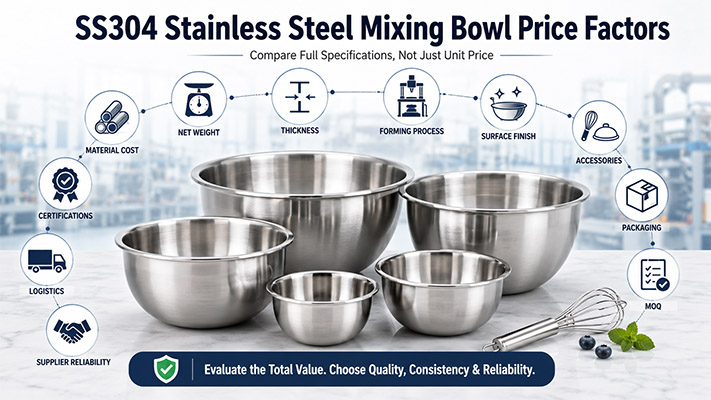
I have seen many buyers receive two quotes for a 24 cm SS304 mixing bowl and feel confused. Both suppliers say “SS304.” Both show a similar photo. But the price can be very different.
This happens because the word “SS304” does not tell the whole story. One bowl may be thinner. One may be heavier. One may have a better rim, better polish, stronger packaging, or stricter testing. So I never suggest comparing price before checking the full product details.
In this article, I will explain the real pricing logic behind SS304 stainless steel mixing bowls. I will use the same way I speak with importers, wholesalers, supermarket buyers, and private label owners.
Why Do Material Grade, Thickness, and Net Weight Matter?
A bowl can look good in a photo. But if it is too thin, it may dent easily and feel cheap in the customer’s hand.
Material grade affects the base cost, but thickness and net weight often explain the real price gap. A heavier SS304 mixing bowl uses more stainless steel sheet, so it usually costs more than a lighter bowl with the same diameter.
SS304 is widely used for quality kitchenware because it has good corrosion resistance and strong food-contact value. Buyers often call it 18/8 stainless steel. It usually costs more than 201 or 430 stainless steel because the material composition is different.
But material grade is only the starting point. I have handled bowls with the same diameter but very different material use. One 24 cm bowl may be thin and light. Another 24 cm bowl may have a thicker body, stronger rim, and better hand feel. Both can be called SS304, but they are not equal products.
This is why I ask buyers to check thickness and net weight together. Thickness gives one part of the answer. Net weight gives a more direct cost signal. If a supplier only gives diameter and material grade, the quote is not complete.
| Factor | Why It Changes Price | What I Check |
|---|---|---|
| Material grade | SS304 costs more than lower grades | Material confirmation |
| Thickness | More thickness means more steel | Exact mm |
| Net weight | More weight means more material | Gram per piece |
| Bowl size | Larger bowls need larger sheets | Diameter and height |
| Rim strength | Stronger rim needs more control | Sample hand feel |
I do not suggest asking only, “How much is a 24 cm SS304 bowl?” A better question is, “How much is a 24 cm SS304 bowl with 0.6 mm thickness, clear net weight, rolled rim, and required packaging?” This gives both sides a fair starting point.
How Do Forming Process and Surface Finish Change the Cost?
A mixing bowl is not only pressed from steel. It must be formed, trimmed, rolled, polished, cleaned, inspected, and packed.
The forming process and surface finish affect labor cost, machine time, and defect rate. Deep bowls, rolled rims, mirror polish, brushed finish, matte finish, and color coating all need more control than a simple low-cost bowl.
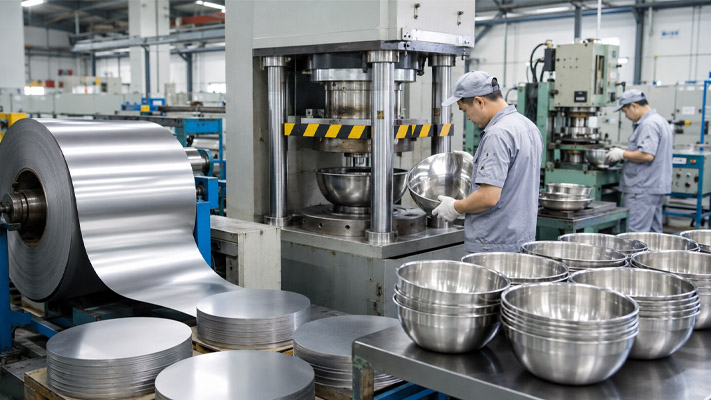
Shape has a direct effect on production difficulty. A simple shallow bowl is easier to make. A deep mixing bowl needs better forming control because the steel must stretch evenly. If the process is unstable, the bowl may have pull marks, uneven thickness, or deformation.
The rim also changes the cost. A rolled rim feels safer and stronger. It also gives the product a more finished retail look. But it adds another process. A simple edge may reduce cost, but it may also reduce comfort and perceived value.
Surface finish is another important part. Basic polish is usually the most cost-effective. Mirror polish looks bright, but it needs more polishing time and better surface control. Brushed finish can look more premium and can hide small scratches better. Color coating or PVD finish can improve shelf appeal, but it also increases defect risk and inspection work.
| Process or Finish | Cost Level | Main Reason |
|---|---|---|
| Simple round shape | Lower | Easier forming |
| Deep bowl shape | Higher | More forming control |
| Rolled rim | Medium | Extra process |
| Mirror polish | Medium to high | More polishing time |
| Brushed finish | Medium | Texture must be even |
| Color coating | Higher | More defect control |
When I develop a bowl for a buyer, I first ask about the sales channel. A supermarket line may need stable quality and clean polish. A premium private label line may need mirror inside and brushed outside. A discount line may need simpler finishing and stronger cost control.
How Much Do Accessories and Packaging Add?
A basic bowl and a retail-ready bowl set are not the same product. The second one needs more parts, more checks, and better packing.
Lids, silicone bases, grater inserts, measurement marks, color boxes, and gift boxes all add cost. They also add value when the target market needs better function, stronger shelf appeal, or higher retail pricing.
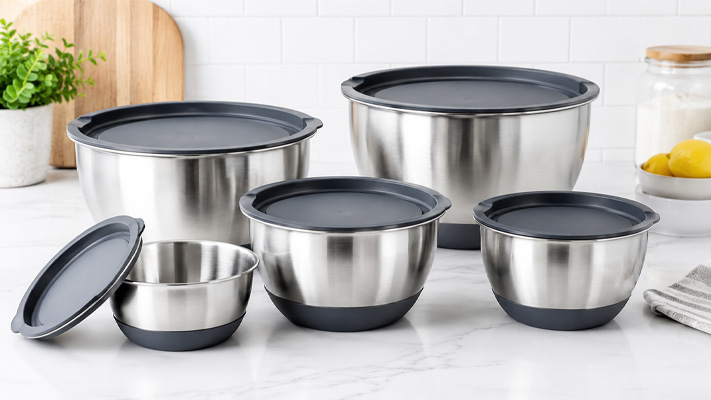
Many buyers now want more than a plain stainless steel bowl. They want mixing bowl sets with lids, non-slip silicone bases, grater lids, measurement marks, and nesting designs. These features help the product sell better, but they also change the cost structure.
A PP lid is not just a plastic cover. It needs the right mold, stable shape, and good fit. If the lid is loose, customers complain. If it is too tight, it becomes hard to use. A silicone base adds non-slip value, but it also adds material, assembly, and bonding control. Measurement marks look simple, but they need a clean and stable process.
Packaging is also part of the price. A PE bag is low cost. A white box is simple. A color box helps supermarket sales. A gift box supports premium positioning. For e-commerce, stronger packaging may be needed to reduce dents and returns.
| Feature | Cost Impact | Buyer Value |
|---|---|---|
| PP lid | Mold and fitting control | Storage function |
| Silicone base | Material and assembly | Non-slip use |
| Measurement marks | Marking process | Baking convenience |
| Grater insert | Extra part and QC | Multi-function value |
| Color box | Printing and design | Better shelf display |
| Gift box | Higher cost and volume | Premium image |
I always suggest matching packaging with the real sales channel. Wholesale buyers may not need a gift box. Supermarket buyers may need a clean color box with barcode. Online sellers may need stronger protection. The cheapest packaging is not always the lowest business cost.
Why Do MOQ, Certifications, and Logistics Affect the Real Price?
The unit price may look simple. But MOQ, testing, carton size, freight, and trade terms can change the final landed cost.
Low MOQ can reduce inventory risk, but it may raise unit price. Certifications add testing and control cost. Logistics affects the final cost after the goods leave the factory.
MOQ has a direct link with price. When the order quantity is small, the factory still needs to prepare material, adjust machines, arrange workers, inspect goods, and manage packing. These costs are shared by fewer pieces, so the unit price is usually higher.
This does not mean low MOQ is bad. I think low MOQ is useful for new product testing. Many buyers do not want to buy a large quantity before they know market response. For them, a 500 pcs trial order can be smarter than a 5,000 pcs order. The unit price may be higher, but the inventory risk is lower.
Certifications also affect cost. If the product is for Europe or North America, the buyer may need food-contact reports. If the set includes plastic lids or silicone bases, those parts may also need testing. I suggest confirming the target market before sampling, not after the product is finished.
Logistics is another hidden area. FOB price is not landed cost. Large bowls and gift sets can take more carton space. A good nesting design can reduce shipping volume.
| Cost Area | What It Means | What I Suggest |
|---|---|---|
| MOQ | Quantity affects unit price | Match MOQ with market stage |
| Testing | Reports may be needed | Confirm early |
| Incoterms | EXW, FOB, CIF, DDP differ | Compare the same term |
| Carton size | Volume affects freight | Ask for packing data |
| Loading quantity | Impacts container cost | Check before order |
A complete quote should include MOQ, sample lead time, mass production lead time, packing method, carton size, gross weight, trade term, and test support. Without these details, the buyer is not seeing the real cost.
How Should Buyers Compare Quotes Without Sacrificing Quality?
A very low price can look attractive. But weak material, poor polish, bad fit, and late delivery can make it expensive.
I suggest buyers compare SS304 mixing bowl quotes with the same RFQ sheet. The RFQ should include material, thickness, net weight, size, finish, accessories, packaging, certification, MOQ, lead time, Incoterms, and QC requirements.
A clear RFQ protects both the buyer and the supplier. When I receive only a photo, I need to guess too many details. Guessing creates misunderstanding. Misunderstanding creates price gaps.
A good RFQ should list the product structure first. This includes diameter, height, capacity, thickness, net weight, rim design, bottom design, and surface finish. Then it should list accessories, packaging, logo method, testing needs, order quantity, and delivery terms.
To reduce cost without hurting quality, I suggest practical choices. Use an existing mold when possible. Choose the right thickness for the target market, not always the thickest one. Use nesting design to reduce shipping volume. Keep premium finishing where customers can see it. Avoid unnecessary packaging layers. Start with a trial MOQ, then increase order quantity after sales data is clear.
| RFQ Item | Details to Confirm |
|---|---|
| Material | SS304 or other grade |
| Size | Diameter, height, capacity |
| Thickness | Exact mm |
| Net weight | Gram per piece |
| Finish | Mirror, brushed, matte, color |
| Accessories | Lid, base, grater, marks |
| Packaging | PE bag, white box, color box, gift box |
| Certification | FDA, LFGB, REACH, EU food contact |
| MOQ | Trial order and bulk order |
| Logistics | EXW, FOB, CIF, or DDP |
For me, supplier capability is also part of the price. A stable factory can reduce hidden cost through better material control, polishing, packing, inspection, and delivery. Since 1997, I have seen that long-term buyers do not always choose the lowest quote. They choose the supplier who can deliver repeatable quality, clear communication, and stable support.
Conclusion
The real price of an SS304 mixing bowl comes from full specification, not one material name. I compare cost, quality, and risk together.