
A cookware sample can look perfect, but the real risk appears when the full shipment arrives. Many buyers discover quality differences too late.
Cookware samples and mass production often differ because samples use extra care and time, while bulk orders depend on material control, machine stability, and systematic quality management to achieve consistent results.
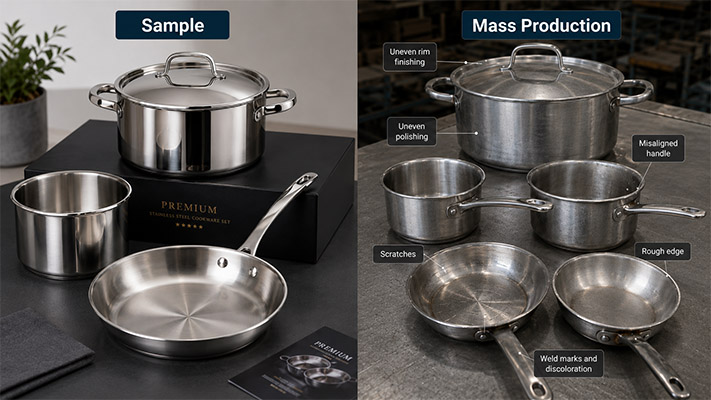
When I speak with cookware importers, one concern appears constantly. The sample looks excellent. Clean finish, solid handle, professional packaging. Then the bulk order arrives and something is different. The surface varies slightly. Handles misalign. Lids fit differently. These small changes become obvious when hundreds of units are displayed together.
At INOXICON, I treat samples as production references, not showpieces. A sample should demonstrate what our team can repeat consistently in bulk orders.
Why Do Cookware Samples Often Look Better Than Mass Production?
Sample making uses slower processes and experienced workers, while mass production must maintain quality under speed and volume pressure.
Samples receive individual attention from skilled technicians with flexible timing, but mass production requires standardized processes that deliver uniform quality across thousands of pieces without manual adjustment for each unit.
Most factories assign their best workers to sample making. Samples get extra polishing time, hand-adjusted handles, and careful packaging inspection. This creates impressive results but also creates problems when the sample process differs too much from normal production methods.
Mass production faces different challenges. Workers change between shifts. Machines run continuously. Raw materials arrive in larger, more varied batches. Polishing equipment wears down. Every variable can affect final quality.
For cookware, visual and physical details matter immediately. Buyers notice loose handles instantly. Customers see uneven surface brightness. Retailers reject inconsistent packaging. The sample must represent achievable production quality, not ideal conditions.
| Production Type | Speed | Workers | Inspection | Risk Level |
|---|---|---|---|---|
| Sample | Slow, careful | Senior technicians | Individual pieces | May exceed normal capability |
| Mass production | Fast, continuous | Full production team | Batch sampling | Depends on system control |
At INOXICON, we design sample processes that can scale to mass production. If a finish requires too much hand adjustment, we standardize it before bulk orders begin.
Which Cookware Details Usually Change During Mass Production?
Surface finish, handle assembly, lid fitting, and packaging show the most common variations between samples and bulk production.
Surface consistency, handle positioning accuracy, and lid fitting precision are critical areas where production variations directly impact both visual appeal and functionality, making systematic control essential for buyer satisfaction.
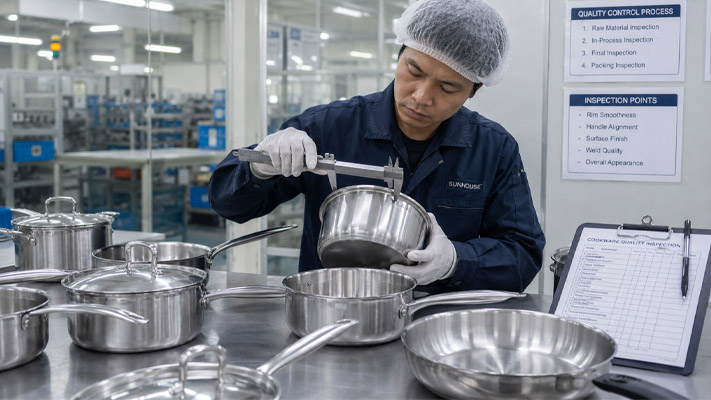
Surface finish problems appear first. Mirror polish, brushed finish, or matte treatments can vary if polishing pressure, wheel condition, or material preparation changes during production. Stainless steel from different batches may polish differently even with identical processes.
Handle assembly creates visible issues when drilling, riveting, or welding varies slightly. Millimeter differences in positioning become obvious when products are stacked. Handle materials like wood or plastic add complexity because they have different tolerances than metal components.
Lid fitting changes when pot body shapes vary during forming processes like stamping and deep drawing. Temperature, pressure, and tool condition all affect final dimensions. A perfectly fitted sample lid may become too tight or loose in mass production.
Material thickness affects product weight and feel. If thickness tolerance is too wide, bulk products feel different from approved samples. Bottom flatness impacts cooking performance and stovetop contact.
Packaging often gets overlooked during sample approval but creates serious problems. Color box printing, carton strength, and protection methods must maintain consistency across large shipments.
| Quality Area | Common Issue | Impact |
|---|---|---|
| Surface finish | Uneven brightness or brushing | Poor shelf appearance |
| Handle assembly | Position variation | User experience problems |
| Lid fitting | Too tight/loose | Functional complaints |
| Material thickness | Weight differences | Perceived value reduction |
| Packaging | Printing or protection failures | Shipping damage |
At INOXICON, we document all critical specifications when buyers approve samples. Material grades, thickness requirements, surface parameters, and assembly standards become production references that guide our manufacturing teams.
How Does INOXICON Control Consistency From Sample to Mass Production?
INOXICON maintains consistency by documenting approved sample specifications, using stable material sources, implementing standardized processes, and conducting systematic quality checks throughout production.
Our 28 years of manufacturing experience has shown that consistency comes from systematic control, not individual craftsmanship. We convert every approved sample into detailed production standards with multiple quality checkpoints.
At INOXICON, we learned that buyers purchase production stability, not just products. When we develop samples, we confirm material grade, thickness, surface finish, handle structure, packaging requirements, and testing standards with buyers. Approved samples become detailed production references, not separate pieces.
We maintain stable raw material suppliers and conduct incoming inspections on every batch. Material consistency is crucial because stainless steel variations affect forming, polishing, and appearance. Our warehouse system ensures materials from the same batch are used throughout individual orders.
Our 95 advanced machines support over 30,000 pieces daily, but capacity means nothing without quality control. We use standardized work instructions developed from approved samples. Each critical process has written procedures, setup requirements, and quality checkpoints.
Surface finishing uses controlled parameters for each finish type. Mirror polish requires specific polishing compounds, wheel speeds, and pressure settings. Brushed finishes need controlled direction, depth, and preparation. We maintain equipment schedules to prevent quality drift.
Assembly operations focus on positioning accuracy and connection strength. Fixtures ensure consistent handle placement. Torque specifications control threaded connections. Pressure settings govern riveted joints.
| Inspection Stage | What We Check | Frequency |
|---|---|---|
| Incoming material | Grade, thickness, surface condition | Every batch |
| Semi-finished | Shape, size, forming results | Every 50 pieces |
| Surface finish | Polish quality, brush direction | Every 25 pieces |
| Assembly | Handle position, lid fit, strength | Every 20 pieces |
| Packaging | Box quality, label accuracy | Every 10 boxes |
| Final inspection | Overall appearance, functionality | Every shipment |
We serve buyers from Japan, South Korea, Europe, and North America. These markets demand strict consistency, which has shaped our comprehensive quality systems. We maintain detailed records including photos, measurements, and test results for future reference.
What Should Cookware Buyers Check Before Approving a Supplier?
Buyers should evaluate production systems, material control, quality processes, and consistency track records, not just sample appearance.
Professional buyers need to assess factory capabilities and systems that ensure long-term quality consistency. The right questions about production control and quality management reveal whether suppliers can deliver reliable results.
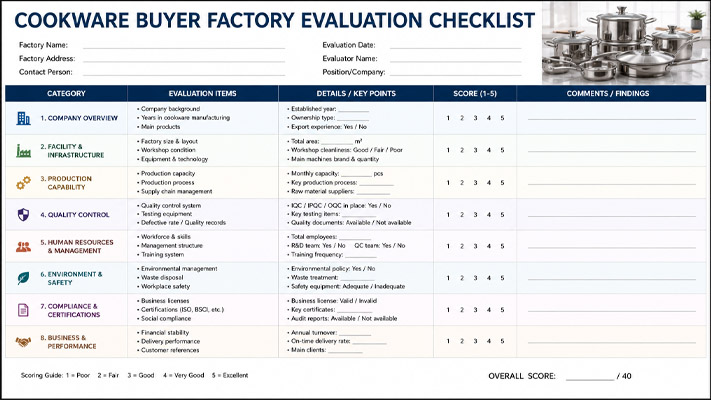
Many buyers focus too heavily on sample appearance while ignoring production capabilities. Before approving suppliers, buyers should ask specific questions about production systems.
How does the factory document approved samples? Professional manufacturers should provide written specifications that become production standards, not just reference pieces.
How does the factory source and control raw materials? Material consistency affects both appearance and performance. Suppliers should explain their sourcing strategy and incoming inspection procedures.
How are surface finishes defined and controlled? Terms like "mirror polish" can mean different things. Factories should provide specific parameters and quality control methods.
What quality control systems operate during production? Factories that only inspect finished products miss problems that develop during manufacturing. Better suppliers use in-process inspection.
How does the factory handle packaging and shipping? Packaging affects protection and retail presentation. Suppliers should explain quality standards and special requirements capabilities.
| Evaluation Point | Why Important | Key Questions |
|---|---|---|
| Sample documentation | Ensures production alignment | Can you provide written specifications? |
| Material sourcing | Prevents quality downgrades | How do you control material consistency? |
| Surface standards | Maintains visual consistency | What parameters control this finish? |
| Quality systems | Shows management capability | Explain your inspection procedures? |
| Export experience | Indicates market knowledge | Which markets do you serve regularly? |
At INOXICON, we welcome detailed questions because professional buyers ask them. Buyers managing brands or retail chains understand that quality consistency protects long-term success.
Why Does the Right Manufacturer Matter More Than One Beautiful Sample?
Long-term business success depends on production reliability and systematic quality management, not just impressive initial samples.
The right manufacturer becomes a strategic partner supporting business growth with consistent quality, reliable delivery, and responsive service. Beautiful samples win first orders, but production consistency wins repeat business.
Price matters, but the lowest price becomes expensive when shipments create complaints, returns, or delays. Hidden quality costs often exceed initial savings.
Reliable manufacturers help buyers reduce business risks and build stable product lines. This matters especially for supermarket suppliers, e-commerce platforms, and private label brands who need consistent quality across batches and reliable delivery timing.
At INOXICON, we support customer business growth beyond manufacturing. We develop over 50 new products yearly and offer both OEM and ODM services. Our low MOQ starting at 500 pieces helps buyers test markets without excessive inventory risk.
Real business begins when products sell well and repeat orders start. Buyers need manufacturing partners supporting consistent quality, reliable schedules, and responsive communication across seasonal demand cycles and market changes.
Innovation capabilities matter for long-term relationships. Markets evolve and manufacturers should support product improvements and new developments. Communication quality affects international coordination across time zones and cultural differences.
At INOXICON, we focus on long-term partnerships. Our 28 years in business and extensive export experience demonstrate commitment to customer success. We understand that customer success drives our growth.
Conclusion
Cookware samples show potential, but mass production proves capability. INOXICON bridges this gap by converting approved samples into systematic production standards for consistent quality delivery.