
Choosing the wrong cookware hub can waste your time, raise your cost, and create quality risks that only appear after mass production starts.
China's main cookware manufacturing hubs are mainly in Guangdong and Zhejiang. Jiangmen and Xinhui are strong in stainless steel cookware, Yongkang and Jinhua are known for aluminum and non-stick cookware, Yangjiang is stronger in kitchen tools, and Chaozhou/Caitang supports stainless steel kitchenware sourcing.
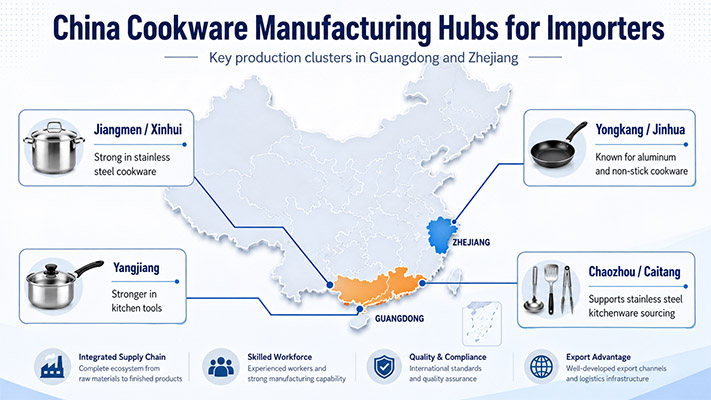
After 29 years in the stainless steel kitchenware industry, I have seen many importers struggle with supplier selection. They often focus only on factory addresses without understanding what each region does best. At INOXICON, we help buyers understand that a manufacturing hub is just the starting point. The real value comes from finding factories with the right capabilities, quality systems, and long-term partnership mindset.
Why Do Cookware Manufacturing Hubs Matter for Importers?
Sourcing cookware without understanding China's industrial hubs can make your supplier search slow, confusing, and full of hidden risks.
Cookware manufacturing hubs matter because they bring together material suppliers, skilled workers, tooling support, polishing workshops, coating partners, packaging suppliers, and export service experience. For importers, the right hub can improve quality control, product development speed, lead time, and cost stability.
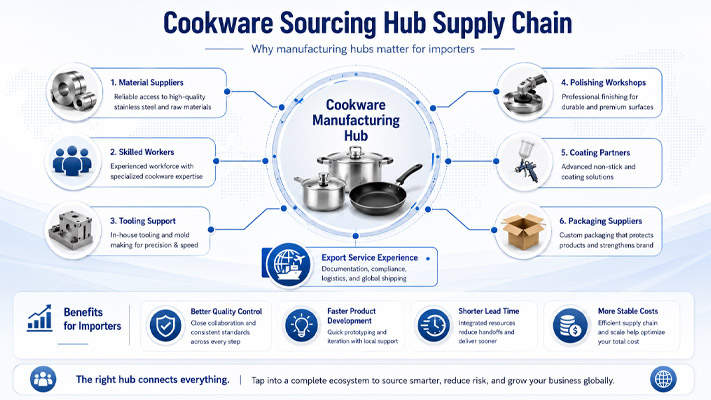
From my experience building INOXICON since 1997, a manufacturing hub creates advantages that individual factories cannot achieve alone. When we need to develop new products for our clients, we can access local material suppliers, mold makers, polishing workshops, and packaging partners within hours, not weeks. This speed helps us deliver over 50 new product designs each year to our global partners.
The supply chain density also helps with quality control. If a batch needs surface treatment adjustment, we can work with nearby polishing specialists immediately. If packaging needs changes for different markets, local packaging suppliers can provide samples the same day. This flexibility has helped us complete over 1,200 successful projects with 500+ clients worldwide. However, I always tell importers that hub advantages only work when the factory knows how to use them properly. Two factories in the same city can have completely different capabilities and quality standards.
What Are the Main Cookware Manufacturing Hubs in China?
If you treat all cookware factories in China as the same, you may choose a region that is not strong in your product category.
The main cookware and kitchenware manufacturing hubs in China include Jiangmen/Xinhui for stainless steel cookware, Yongkang/Jinhua for aluminum and non-stick cookware, Yangjiang for knives and kitchen tools, Chaozhou/Caitang for stainless steel kitchenware, and the Pearl River Delta for supporting supply chain services.
After working with importers from over 50 countries, I have learned that product definition must come before supplier selection. Many buyers contact us asking for "cookware suppliers" without specifying whether they need stainless steel stockpots, aluminum fry pans, or kitchen utensils. Each product category requires different manufacturing expertise and supply chain support.
At INOXICON, we focus on stainless steel kitchenware because that is where we built our expertise over 27 years. We understand the material grades, forming processes, polishing standards, and quality control methods that stainless steel products require. This specialization allows us to offer better quality, faster development, and more reliable delivery than factories that try to make everything. I advise importers to match their product needs with regions that have developed the right industrial capabilities, then focus on finding factories with proven track records in those specific product categories.
Why Are Jiangmen and Xinhui Important for Stainless Steel Cookware?
A stainless steel cookware sample may look good, but mass production can fail if the factory lacks process control.
Jiangmen and Xinhui are important sourcing areas for stainless steel cookware in China. They are suitable for stockpots, saucepans, steamers, cookware sets, and composite bottom cookware. Buyers should check material grade, thickness, welding, polishing, bottom structure, and packaging before placing orders.

These regions developed strong capabilities in stainless steel cookware because of early investments in forming equipment and welding technology. Factories here understand how to control material thickness during deep drawing, achieve consistent welding on handles, and maintain mirror finishes during large production runs. The local supply chain also supports cookware-specific needs like composite bottom materials and food-grade handle components.
However, location alone does not guarantee quality. In my experience helping importers evaluate suppliers, I have seen factories in the same industrial park with completely different standards. One may use precise material testing, controlled polishing processes, and strict packaging inspection. Another may cut costs through thinner materials, loose quality control, and weak packaging that causes shipping damage. The difference only becomes clear during mass production when consistency matters most for your brand reputation. This is why I recommend that importers always verify factory capabilities through facility visits, sample evaluations, and reference checks before placing large orders.
Why Are Yongkang and Jinhua Strong in Aluminum and Non-Stick Cookware?
A low-priced non-stick pan can look attractive, but poor coating or thin material can quickly damage your customer reviews.
Yongkang and Jinhua are strong sourcing areas for aluminum cookware, non-stick pans, woks, and cookware sets. They are attractive for buyers who need cost flexibility and many supplier options. Buyers should check coating quality, pan thickness, handle strength, heat distribution, and batch consistency.
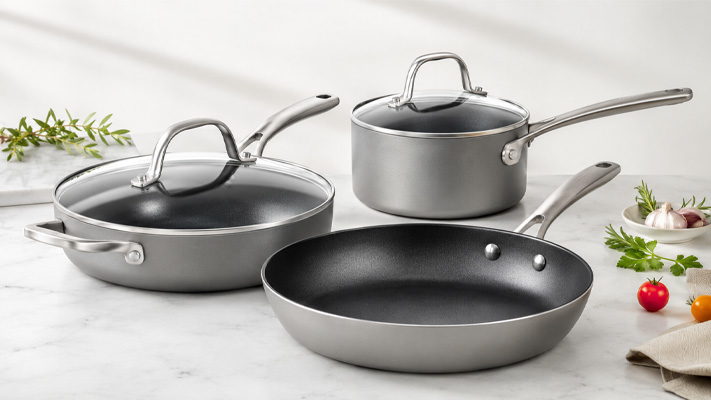
These regions built expertise in aluminum processing and coating applications through their hardware manufacturing history. Local suppliers provide aluminum sheets, coating materials, and application equipment. Factories learned to manage production costs while maintaining acceptable quality for price-sensitive markets.
The challenge with aluminum and non-stick products is that quality differences often hide behind similar appearances. Coating thickness, aluminum body strength, and heat distribution properties all affect long-term performance, but these factors are hard to evaluate from photos or quick inspections. Poor coating may peel after short use. Thin aluminum may warp on high heat. Weak handle assembly creates safety risks. These problems only appear after consumers start using the products. At INOXICON, we focus on stainless steel kitchenware partly because stainless steel offers more predictable long-term performance than coated aluminum products. For importers considering aluminum cookware, I recommend requesting detailed specifications, coating durability test reports, and clear quality standards before production begins.
How Should Importers Choose Based on Product Type?
If you choose a supplier before defining your product type, you may compare the wrong factories and waste weeks of communication.
Importers should choose a cookware hub based on product type first. Jiangmen/Xinhui fits stainless steel cookware, Yongkang/Jinhua fits aluminum and non-stick cookware, Yangjiang fits kitchen tools, and Chaozhou/Caitang fits stainless steel kitchenware. For OEM/ODM projects, factory capability is more important than location alone.
Product definition affects everything from supplier selection to quality control methods. Stainless steel cookware needs material grade verification, welding strength checks, and bottom flatness testing. Aluminum non-stick cookware needs coating durability tests and heat distribution evaluation. Kitchen knives need blade hardness and edge retention testing. Stainless steel kitchenware needs rim safety and surface finish consistency checks.
At INOXICON, we help importers understand these differences through our product development process. Our design and engineering teams work with clients to define product specifications, quality standards, and testing methods before production begins. This approach prevents the common problem where samples look good but mass production fails to meet expectations. We also offer flexible MOQ starting from 500 pieces for many items, which allows importers to test products and markets without heavy inventory pressure. This flexibility has helped many of our partners expand their product lines successfully over the years.
Why Does Factory Capability Matter More Than Location?
A famous hub can help you find suppliers, but it cannot guarantee stable quality, fast delivery, or real OEM support.
Factory capability matters more than location because quality depends on equipment, workers, material control, inspection standards, production management, and communication. Even in the same manufacturing hub, two factories can produce very different results in thickness, finish, packaging, delivery, and mass production consistency.
After building INOXICON's production capabilities over 27 years, I can tell you that equipment and systems make the biggest difference in quality consistency. Our 95 advanced machines help us maintain precise forming, consistent polishing, and reliable welding across our daily production of over 30,000 pieces. Modern stamping equipment creates more accurate shapes than older machines. Automated polishing lines produce more consistent surface finishes than manual processes.
However, equipment alone is not enough. Production management systems determine whether factories can repeat sample quality during mass production. Some factories focus only on current orders without building systems for long-term consistency. Others invest in worker training, process documentation, and quality inspection protocols that support reliable partnerships. At INOXICON, we developed detailed production standards and inspection checkpoints because our clients depend on consistent quality for their brand reputation. This investment in systems and training allows us to maintain quality across repeat orders and custom development projects, which has helped us build lasting partnerships with importers in Europe, North America, and Asia.
What Quality Factors Should Buyers Check?
If you only check product photos and unit prices, you may miss the details that create returns, complaints, and shipment problems.
Buyers should check material grade, thickness, surface finish, handle strength, bottom structure, packaging, and compliance when sourcing cookware from China. These factors affect food safety, durability, user experience, retail value, shipping damage rate, and market access.
Quality control starts with clear specifications before production begins. Material grades affect food safety and durability. For stainless steel products, I recommend confirming exact grades like 304 or 201 stainless steel, along with thickness tolerances. Wrong materials can cause food safety issues or regulatory compliance failures that block market access.
Surface finish standards need precise definition because they affect retail presentation and customer satisfaction. At INOXICON, we developed detailed polishing standards through our 27 years of manufacturing experience. Mirror polish, brushed finish, and matte finish each require specific inspection criteria. Scratches, polishing lines, and uneven areas can make products look cheap on retail shelves and damage brand perception. We also pay close attention to rim safety for bowls and containers, handle strength for larger items, and packaging protection to prevent shipping damage. These details may seem small, but they determine whether your products build customer loyalty or create returns and complaints. I always recommend that importers define quality standards clearly and verify that suppliers can maintain those standards throughout mass production.
Conclusion
China offers multiple cookware manufacturing hubs, but success depends on matching your product type with regional strengths, then finding factories with proven capabilities and quality systems.