
Many Amazon sellers find a product idea first. Then a weak factory turns that idea into quality problems, slow restocking, and bad reviews.
To choose a drinkware manufacturer for Amazon private label, focus on stable bulk quality, practical customization, FBA-ready packaging, compliance support, flexible MOQ, sample control, and long-term product development. The right manufacturer should protect the launch and support repeat growth.
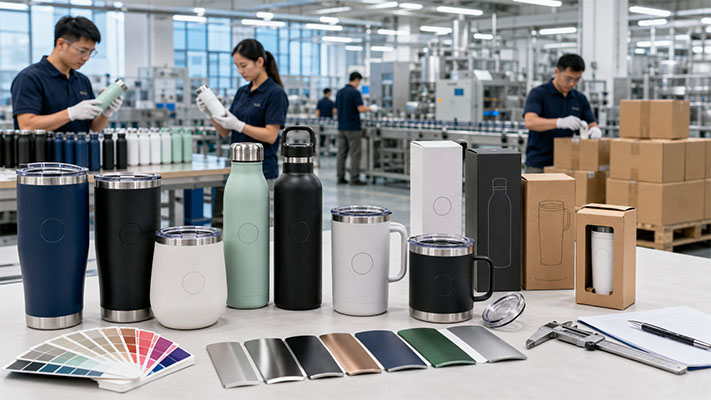
A drinkware product may look simple, but it carries many details. The cup must feel right. The lid must fit well. The coating must stay clean. The logo must look sharp. The box must protect the product. The factory must also understand how Amazon sellers work. A good manufacturer is not only a place that makes cups. It is a partner that helps turn a product idea into a private label item that can be sold, reviewed, restocked, and improved.
Before choosing by price, the buyer should look at the full sourcing risk. Low price can help a listing compete, but poor quality can damage the listing faster. A better choice is to find a manufacturer that understands Amazon private label needs from the first sample to future product expansion.
Share your brand idea with Inoxicon. Inoxicon can suggest practical logo, color, packaging, sample, and MOQ options for your Amazon drinkware launch.
How Can You Judge Real Manufacturing Stability?
A sample can look perfect. Bulk production is the real test. Many Amazon problems start when the final goods do not match the approved sample.
A stable drinkware manufacturer should control key production steps and keep bulk quality close to the approved sample. Buyers should check production experience, process control, coating quality, lid fitting, final inspection, and packing standards.
Why stable production matters
Drinkware is used often, so small defects are easy to notice. A sharp edge can create a bad user experience. A weak coating can lead to scratches. A loose lid can cause leakage. A rough logo can make the brand look cheap. These problems may not be serious in a factory showroom, but they can become serious on Amazon because customers leave public reviews.
A real manufacturer should explain how the product is made. For stainless steel drinkware, important steps may include material cutting, forming, welding, polishing, coating, printing, assembly, inspection, and packing. A factory that controls more key steps usually has better control over final quality. A supplier that outsources too many steps may still be useful, but the buyer should check how they control each outside process.
The key point is sample-to-bulk consistency. The approved sample is not only a reference. It is the standard for mass production. The buyer should ask how the factory controls color, logo position, coating thickness, lid fit, capacity, and final appearance. Clear inspection photos and packing photos before shipment can also reduce risk.
| What to Check | Weak Supplier Signal | Strong Manufacturer Signal |
|---|---|---|
| Production experience | Only gives general answers | Explains drinkware process clearly |
| Process control | Does not know key details | Controls or tracks key steps |
| Sample-to-bulk consistency | Says “do not worry” | Uses approved sample as standard |
| Lid and leakage control | No clear test method | Checks fit, seal, and function |
| Surface finish | Cannot explain coating process | Knows finish type and risk points |
| Final inspection | Only checks carton count | Checks product, logo, box, and packing |
A small sourcing tip
Do not only ask, “Can you make this product?” A better question is, “How do you keep the bulk order close to the approved sample?” This question pushes the factory to explain its real process. It also helps the buyer see whether the supplier understands quality control or only wants to close the order.
Another useful question is, “What problems have you seen in similar drinkware orders?” A strong manufacturer will not pretend that production has no risk. Instead, it can explain common issues and how to prevent them. This is often a better sign than a supplier that only says “everything is fine.”
For Amazon private label, stability is more valuable than a beautiful one-piece sample. The listing needs repeatable quality, not one lucky product.
What Private Label Support Matters Beyond a Logo?
Many suppliers say they support private label. In many cases, they only mean logo printing. That is not enough for Amazon.
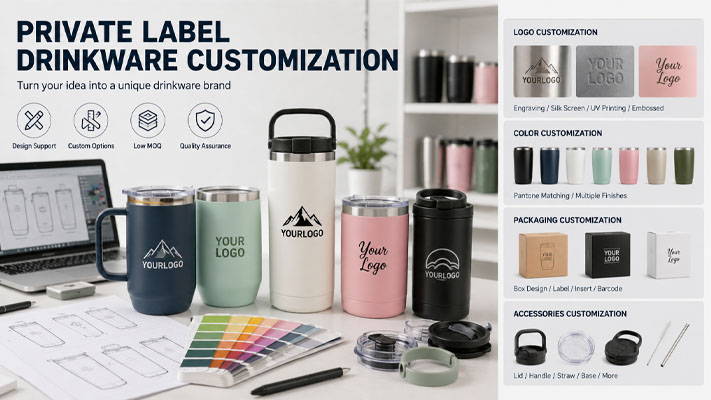
Private label drinkware support should include logo method, color planning, packaging style, product positioning, MOQ planning, and launch-stage customization. A strong manufacturer helps sellers choose practical options instead of pushing unnecessary customization.
Private label should match the launch stage
A new Amazon seller does not always need full custom tooling. Full mold development may be useful for a mature brand, but it can add cost, time, and risk at the beginning. A practical first order often uses an existing proven model with a custom logo, selected colors, and simple branded packaging. This gives the seller a faster way to test demand.
Logo customization should also be discussed carefully. Laser engraving can give stainless steel drinkware a clean and premium look. Silk screen printing can work for simple logos. Heat transfer or UV printing can support colorful patterns. Embossing or debossing can create a stronger brand feel, but it may require tooling or special parts. The best method depends on the product material, surface finish, target price, order quantity, and brand style.
Color customization is another important part of private label. Many Amazon products look similar, so color can help create difference. But color must also be practical. A trendy color may attract attention, while a classic color may be easier to restock. The buyer should ask about Pantone matching, color MOQ, finish options, and color repeatability for future orders.
| Customization Option | Best For | Main Risk |
|---|---|---|
| Existing model + logo | First test order | Brand difference may be limited |
| Existing model + custom color | Better Amazon visual appeal | Color MOQ may increase |
| Custom packaging | Stronger unboxing and gift value | Box cost and printing time |
| Custom accessory | Higher product value | Fit and function must be tested |
| Custom mold | Mature brand expansion | Higher cost and longer timeline |
Practical customization creates better control
Private label does not mean everything must be changed. Too many changes in the first order can create more chances for mistakes. A smart product plan should balance brand difference and production control.
For example, a first launch may use one proven tumbler shape, two or three colors, one logo method, and one packaging style. After sales data becomes clear, the seller can add more colors, improve the box, develop a matching size, or create a bundle. This step-by-step method helps reduce inventory pressure and gives the brand space to grow.
Packaging should also match the product price point. A giftable tumbler needs better box presentation. A value product still needs clean and protective packaging, but it may not need expensive printing. The manufacturer should help the buyer choose the right level.
Send your logo, target color, and packaging idea to Inoxicon. Inoxicon can help compare logo methods, color options, packaging styles, and MOQ plans before the order becomes too complex.
Can the Factory Handle FBA Packaging and Compliance?
A good product can still fail if packaging is weak or compliance is unclear. Amazon sellers need to treat these details early.
A drinkware manufacturer for Amazon private label should understand FBA-ready packaging, barcode handling, carton strength, unit protection, and market compliance support. These details help reduce damage, delays, return risk, and review problems.
FBA packaging is part of the product experience
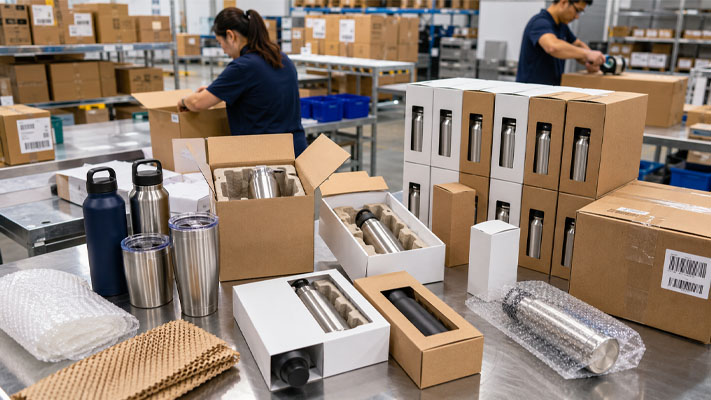
Drinkware goes through many steps before reaching the customer. It may move from factory packing to export shipping, then to warehouse handling, storage, and final delivery. Weak packaging can create scratches, dents, broken lids, crushed boxes, and poor unboxing. The customer will not know where the damage happened. The customer only sees the brand.
FBA packaging does not have to be expensive, but it must be planned. The buyer should confirm the unit box, inner protection, barcode label area, carton marks, carton size, carton weight, and packing method. If the product has a polished or coated surface, inner protection is especially important. If the drinkware is positioned as a gift, the retail box should also support that feeling.
A manufacturer does not need to be an Amazon agency. But it should understand that Amazon sellers face warehouse rules, customer reviews, and strict delivery expectations. A factory that has worked with e-commerce sellers before may be better prepared for unit packing, label placement, and packing photos.
| Packaging Detail | Why It Matters |
|---|---|
| Unit box | Protects the item and improves unboxing |
| Inner protection | Reduces scratches, dents, and lid damage |
| Barcode label area | Supports warehouse handling |
| Carton strength | Protects goods during transport |
| Carton size and weight | Affects shipping and storage planning |
| Packing photos | Confirms details before shipment |
Compliance should not be left until the end
Drinkware touches food and drinks, so safety documents matter. Different markets may require different tests or declarations. The buyer may need food-contact testing, material information, coating details, BPA-related documents for plastic or silicone parts, or other compliance support based on the target country and sales channel.
A strong manufacturer should know the materials used in the product. It should also explain whether existing test reports are available and whether new third-party testing can be arranged. The buyer should check if the report matches the actual product, not only a similar item. A report for another product may not solve the buyer’s compliance problem.
Compliance support is not only paperwork. It shows how serious the manufacturer is about materials, production, and export markets. A supplier with a very low price but unclear material information may create more risk than savings.
For Amazon sellers, packaging and compliance are not exciting topics, but they protect the listing. They reduce hidden costs before problems happen.
Contact Inoxicon before confirming your drinkware packaging plan. Inoxicon can discuss FBA-friendly unit packaging, barcode handling, carton planning, and compliance support based on your target market.
How Should Samples, MOQ, and First Orders Be Managed?
Many private label projects become risky because the first order is too large, too custom, or approved too quickly.
A better first order should start with proper samples, clear MOQ choices, controlled customization, and confirmed packaging. This helps Amazon sellers test the market without putting too much cash into unproven inventory.
Samples reduce mistakes before mass production
A drinkware sample should be checked like a customer would check it. The buyer should hold it, open the lid, test the seal, touch the coating, smell the silicone part, inspect the logo, and look at the box. Photos are useful, but they cannot replace the feeling of the real product.
There are different sample stages. A stock sample checks shape, size, and basic quality. A logo sample checks brand effect. A color sample checks surface finish and color accuracy. A packaging sample checks box strength and customer presentation. A pre-production sample confirms the final version before mass production.
Not every order needs every sample stage. But the factory should explain which stage is necessary. If a supplier pushes the buyer to skip samples, the buyer should be careful. A sample cost is usually much smaller than the cost of fixing a full shipment.
| Sample Type | What It Confirms |
|---|---|
| Stock sample | Shape, size, weight, structure |
| Logo sample | Logo size, position, and method |
| Color sample | Finish, tone, and surface quality |
| Packaging sample | Box strength and brand presentation |
| Pre-production sample | Final details before bulk order |
MOQ should match the launch plan
Low MOQ is useful, but it should be understood in the right way. The lowest MOQ may limit color choice, packaging type, or logo method. A higher MOQ may allow better customization, but it also creates more inventory pressure. The best MOQ is the one that fits the seller’s launch stage, cash flow, and sales plan.
For a first Amazon order, a common low-risk path is to use an existing model, choose one or two strong colors, add a clean logo, and keep packaging simple but protective. After the product gets sales data, the seller can improve the next order. This reduces risk and gives the brand real market feedback.
| Order Stage | Recommended Focus | Reason |
|---|---|---|
| First test order | Existing model + logo | Faster launch and lower risk |
| Second order | Add stronger color options | Builds brand identity |
| Third order | Improve packaging or accessory | Raises customer value |
| Growth stage | Develop new size or design | Expands the product line |
| Mature stage | Custom mold or full series | Builds stronger difference |
A small buying tip
Do not ask only, “What is your MOQ?” Ask, “What is the MOQ for this model, this color, this logo method, and this packaging?” This gives a much clearer picture. It also prevents surprise costs later.
A good manufacturer should help the seller choose a first order structure that is realistic. The goal is not to make the first order look impressive. The goal is to launch safely, learn from the market, and keep room for improvement.
Share your first order quantity and target selling price with Inoxicon. Inoxicon can suggest a practical sample and MOQ plan for your Amazon private label drinkware project.
Can the Manufacturer Help Your Amazon Brand Grow Long Term?
The first order is only the start. A private label brand needs restocking, improvement, new styles, and steady support.
A strong drinkware manufacturer should support repeat orders, product updates, new colors, new sizes, new packaging, and OEM or ODM development. This helps Amazon sellers build a product line instead of selling only one item.
Long-term support is often more valuable than a low first price
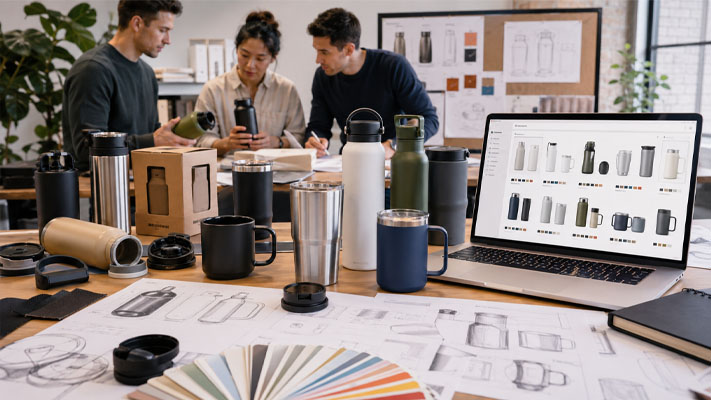
Amazon competition changes quickly. A simple drinkware product can be copied. A brand needs better details, better packaging, better user experience, and new product ideas. A basic supplier waits for instructions. A stronger manufacturer suggests options based on production experience.
Customer reviews can also guide future product improvement. If buyers complain that the lid is hard to clean, the next version can use a simpler lid structure or a wider mouth. If buyers want easier carrying, the product may need a handle, loop, or bag. If buyers buy the item as a gift, the packaging can become more gift-ready. If one color sells better than others, the brand can build a color series around that style.
Restocking is also important. A good listing can lose momentum when inventory runs out. The manufacturer should keep clear records of logo files, color references, packaging files, approved samples, and order details. This makes repeat orders smoother and reduces mistakes.
| Amazon Growth Need | Factory Support |
|---|---|
| Stable restocking | Clear lead time and repeat production |
| Better reviews | Product improvement based on feedback |
| More SKUs | New colors, sizes, lids, and accessories |
| Higher value | Better finish, packaging, or bundle |
| Seasonal sales | Trend colors and gift packaging |
| Brand expansion | OEM and ODM product development |
Product development should be part of supplier selection
When choosing a drinkware manufacturer, the buyer should ask whether the factory develops new products each year. This question matters because a private label brand needs fresh options. New designs can help the seller test new niches, create bundles, refresh old listings, and build a stronger catalog.
A useful manufacturer may suggest product families. For example, one successful tumbler can expand into different sizes. A water bottle can be matched with a travel mug. A best-selling color can be used across several products. A product can also be bundled with straws, brushes, spare lids, or gift boxes.
This type of support helps the buyer think beyond one order. It also helps the brand become harder to copy. Competitors may copy a single cup, but they have a harder time copying a full product plan with consistent color, packaging, and user experience.
Inoxicon supports stainless steel kitchenware and drinkware-related OEM and ODM projects with practical customization, low MOQ options for many items, and continuous new product development. If your goal is to build a long-term Amazon private label line, Inoxicon can help plan the next product, not only the first order.
Conclusion
Choosing a drinkware manufacturer for Amazon private label is not only about price. The right partner should support quality, branding, packaging, compliance, MOQ, samples, restocking, and future growth.
Send your drinkware private label idea to Inoxicon. A practical manufacturing plan can help reduce launch risk and give your Amazon brand a stronger start.