
A bowl order can look simple. But wrong thickness, weak finish, or poor packing can turn a good retail plan into costly complaints.
To source SS304 stainless steel mixing bowls, buyers should confirm material grade, size range, wall thickness, finish, rolled rim, stackability, logo method, packing, samples, MOQ, lead time, and supplier quality control before placing an order.

For importers, wholesalers, supermarket buyers, and Amazon sellers, stainless steel mixing bowls are not only daily kitchen items. They are product-line decisions. A good bowl must match the target price, look clean on the shelf, survive shipping, and support repeat sales. That is why I always suggest buyers define the full specification before asking for a quotation.
Why Choose SS304 Mixing Bowls for Retail and Wholesale?
Many buyers start by comparing price. That is normal. But if the material grade is wrong, the lowest price can create higher costs later.
SS304 stainless steel mixing bowls are often chosen for retail and wholesale because they offer better corrosion resistance, stronger quality positioning, and better long-term value than many lower-grade stainless steel options.
SS304 is a better choice when buyers sell to supermarkets, homeware stores, kitchenware distributors, Amazon customers, or private label channels. These markets care about product appearance, food-contact use, durability, and customer reviews. A bowl that looks good at first but rusts or deforms later can damage both the retailer and the supplier.
This does not mean every market must use SS304. Some price-sensitive markets may still choose SS201. But if the buyer wants to build a stable product line and avoid quality complaints, SS304 gives the product a safer foundation.
| Material Option | Best For | Buyer Value | Risk |
|---|---|---|---|
| SS304 | Mid-range and premium retail | Better corrosion resistance and stronger product image | Higher unit cost |
| SS201 | Price-sensitive wholesale | Lower price | Higher risk of rust complaints |
| SS430 | Some budget kitchenware | Lower cost | Not always ideal for mixing bowls |
When I review a bowl project, I do not only ask, “What is the price?” I ask where the product will be sold, what price point the buyer wants, and how long the product should support repeat orders. The right material must match the market. For many buyers, SS304 is not just a material choice. It is a way to reduce after-sales risk and build trust with local customers.
What Specifications Should Buyers Confirm Before RFQ?
A vague RFQ creates slow replies and inaccurate pricing. If the buyer only asks for “stainless steel mixing bowl price,” the supplier must guess too many details.
A complete stainless steel bowl RFQ should include material, diameter, depth, wall thickness, finish, rim type, stackable design, logo method, packing, quantity per SKU, annual volume, sample request, and target market.
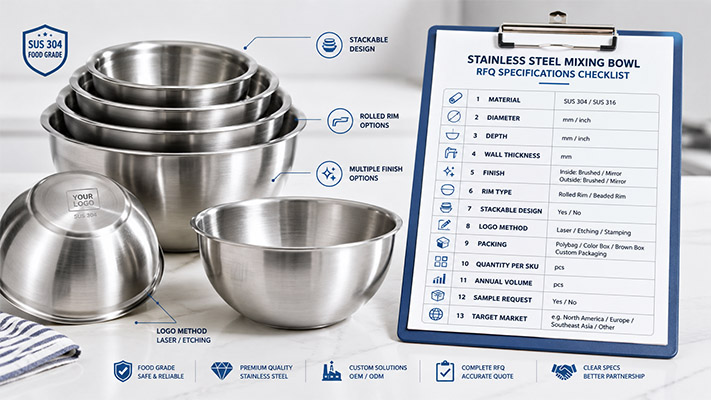
A clear RFQ helps the factory quote faster and more accurately. It also helps the buyer compare suppliers on the same standard. If one supplier quotes 0.20 mm and another quotes 0.30 mm, the prices should not be compared directly. If one price includes retail packaging and another price only includes bulk packing, the result is also not fair.
A good RFQ can look like this:
| RFQ Item | Example Specification |
|---|---|
| Material | SS304 |
| Diameter | 160 / 180 / 220 / 260 / 280 / 320 mm |
| Depth | 60 / 90 / 110 mm |
| Wall Thickness | 0.20 mm |
| Interior Finish | Bright polish |
| Exterior Finish | Matte finish |
| Rim | Defined rolled rim |
| Structure | Stackable |
| Logo | Removable logo sticker |
| Packing | 12 pcs per master carton |
| Sample | 1 prototype set |
| Annual Volume | 12,000 pcs total |
These details are not small. Diameter and depth affect use cases. Thickness affects cost and hand feel. Finish affects shelf appearance. Rim design affects safety and strength. Packing affects shipping damage and warehouse handling.
At INOXICON, a complete RFQ helps our team review material cost, production process, sample timing, carton method, and MOQ from the beginning. It also reduces repeated communication. For serious buyers, this makes the project faster and easier to control.
How Should Buyers Plan Sizes, Thickness, Finish, and Packing?
A stainless steel bowl line should not be planned as one single item. Buyers need to think about how the product will be sold.
For retail and wholesale programs, buyers should plan the size range, wall thickness, surface finish, rolled rim, stackability, logo, and packing based on the sales channel and target price.
A practical size range can cover small prep use, normal mixing, salad preparation, baking, and bulk food preparation. For example, a 6-SKU range can help supermarkets and distributors serve more customer needs.
| Bowl Size | Depth | Common Use | Suitable Channel |
|---|---|---|---|
| Ø160 mm | 60 mm | Sauce, eggs, small prep | Retail, supermarket, Amazon |
| Ø180 mm | 60 mm | Fruit, ingredients, small salad | Retail, supermarket |
| Ø220 mm | 90 mm | Mixing and baking prep | Retail, wholesale |
| Ø260 mm | 90 mm | Salad, dough, family cooking | Wholesale, supermarket |
| Ø280 mm | 110 mm | Large mixing | Wholesale, restaurant supply |
| Ø320 mm | 110 mm | Bulk preparation | Wholesale, food service |
Wall thickness must also match the market. A 0.20 mm SS304 bowl can work for some entry or mid-range retail programs if production control is stable. It gives buyers a more competitive price. But larger bowls may need stronger thickness or better structure because weak hand feel becomes more obvious as the diameter increases.
| Thickness | Positioning | Buyer Benefit | Point to Check |
|---|---|---|---|
| 0.20 mm | Entry to mid-range | Competitive price | Shape stability and packing protection |
| 0.25 mm | Mid-range | Better hand feel | Cost and retail price |
| 0.30 mm+ | Premium | Stronger structure | Higher material cost |
Finish and rim design should not be treated as decoration only. A bright interior makes the bowl look clean for food preparation. A matte exterior gives a more modern retail look. A defined rolled rim improves hand feel, edge safety, and structure. If the rim is sharp, uneven, or weak, the product will feel cheap even if the material is SS304.
Packing should be decided early. Wholesale buyers may prefer 12 pcs per master carton. Retail buyers may need barcode labels, removable logo stickers, paper sleeves, or color boxes. Amazon sellers may need better inner protection to reduce scratches and dents. If packing is only discussed after price confirmation, the final cost may change again.
How Should Samples, MOQ, and Lead Time Be Handled?
Skipping samples can save a few days, but it can create bigger delays after mass production. This is especially true for multi-size bowl programs.
Buyers should request a prototype set before mass production to confirm size, depth, thickness, weight, finish, rim, stackability, logo sticker, and packing standard.
A 6-SKU product line should be checked as a full set. One small bowl cannot represent the full order. Larger bowls may have different forming risks, polishing marks, rim control issues, or stacking problems. The buyer should measure each size, compare the actual weight, check the finish, test stacking, and review the logo position.
| Sample Stage | What to Check |
|---|---|
| Prototype Set | Size, thickness, shape, finish, rim |
| Logo Sample | Sticker quality, position, residue |
| Packing Sample | Carton size, label, protection |
| Pre-Production Sample | Final standard before bulk order |
| Mass Production QC | Match with approved sample |
MOQ, price, and lead time are also linked to the specification. SS304 material, number of SKUs, thickness, surface finish, logo method, packing type, and sample approval all affect the final offer.
| Factor | Impact on Price | Impact on Lead Time |
|---|---|---|
| SS304 Material | Higher than SS201 | Depends on material availability |
| Multiple SKUs | More setup and QC work | Longer planning time |
| Matte Exterior | More finish control | May need more processing time |
| Custom Logo | Extra cost | Depends on logo method |
| Retail Packing | Higher packing cost | Needs packaging preparation |
| Sample Approval | Reduces mass production risk | Affects project schedule |
I suggest buyers confirm the approved sample in writing. The approved sample should become the production reference. If thickness, finish, logo, or packing changes later, both sides should confirm the change again. This avoids confusion during inspection and shipment.
How Can Buyers Choose the Right Stainless Steel Bowl Manufacturer?
A supplier should not only give a low price. A good supplier should help the buyer control risk from product development to repeat orders.
Buyers should compare stainless steel mixing bowl manufacturers by experience, material control, polishing quality, rim consistency, sample support, QC process, packing ability, communication speed, and export experience.
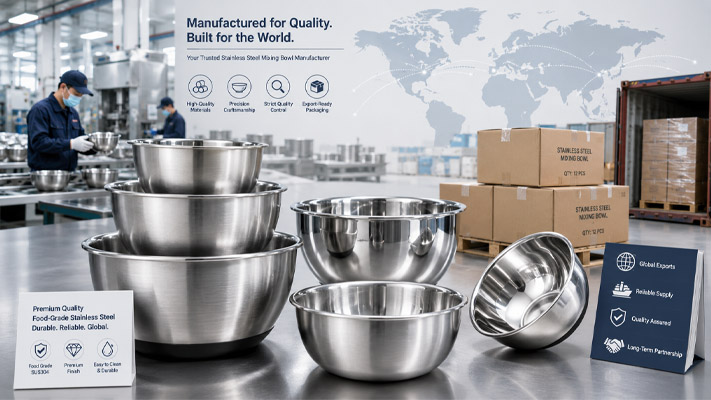
For stainless steel bowls, many problems are process problems. The material must be correct. The forming must be stable. The rim must be smooth. The finish must be consistent. The bowls must stack well. The carton must protect the product during long-distance shipping.
| Supplier Checkpoint | Why It Matters |
|---|---|
| Manufacturing Experience | Reduces development risk |
| Stable Capacity | Supports repeat orders |
| Sample Support | Confirms details before mass production |
| QC Process | Protects product consistency |
| OEM/ODM Ability | Supports private label growth |
| Flexible MOQ | Helps buyers test new markets |
| Export Experience | Reduces communication and shipping risk |
INOXICON has produced stainless steel kitchenware since 1997. We support importers, wholesalers, supermarkets, and private label buyers with product development, sample confirmation, production, quality control, and packing solutions.
If you are sourcing SS304 stainless steel mixing bowls for retail, wholesale, supermarket, Amazon, or private label sales, send us your RFQ with diameter, depth, thickness, finish, rim, logo, packing, quantity, and target market. Our team can review your project and prepare a clear quotation.
Conclusion
A good SS304 mixing bowl order starts with clear specifications. Define size, thickness, finish, rim, packing, samples, MOQ, and supplier standards before you buy.