
A low quote can look attractive, but one weak aluminum cookware shipment can lead to returns, complaints, and lost buyers. That is where many importers get hurt.
The best way to buy aluminum pots and pans wholesale from China is to compare suppliers beyond price, confirm exact specifications early, check compliance for your market, and control quality before shipment. Buyers who treat purchasing as a system usually reduce risk and protect margins more effectively.
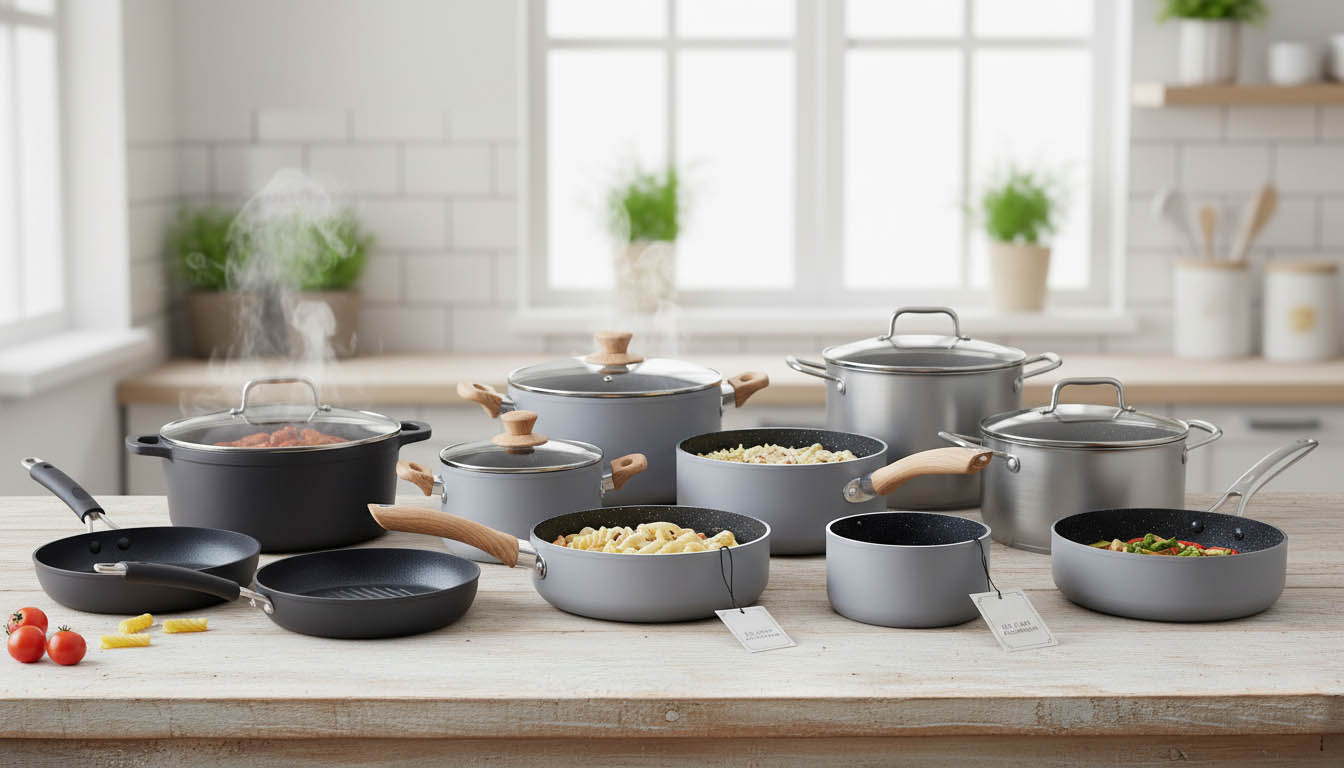
Aluminum pots and pans remain one of the most practical cookware categories for wholesalers, importers, and growing kitchenware brands. They are lightweight, cost-effective, and flexible in design, which makes them suitable for supermarkets, distributors, e-commerce sellers, and private label programs. But the opportunity comes with real purchasing pressure. Product thickness, coating quality, handle strength, packaging performance, and supplier consistency all affect whether your order becomes a profitable repeat line or a costly problem. That is why serious buyers do not look at aluminum cookware as a simple commodity. They evaluate it as a supply chain decision. In this guide, I will walk through the key points that matter most before you place a bulk order from China, so you can buy with more control and fewer surprises.
Why Do Importers Still Buy Aluminum Pots and Pans from China?
Many buyers want lower cost, but they also fear poor quality and unstable factories. China still works well when the purchasing process is handled properly.
China remains a strong manufacturing base for aluminum cookware because it offers competitive pricing, broad factory options, flexible customization, and scalable production. For importers and wholesalers, the real advantage is not just lower cost. It is the ability to build product lines across multiple price levels and sales channels.
Importers continue to buy aluminum pots and pans from China because the category fits a wide range of commercial needs. A buyer can purchase entry-level frying pans for discount retail, mid-range non-stick cookware sets for e-commerce, or more polished private label items for specialty kitchen brands. That flexibility matters. China also has a mature supply chain for related components such as glass lids, bakelite handles, induction bottoms, packaging materials, and logo decoration. This makes product development faster and easier to scale.
For many overseas buyers, aluminum cookware is attractive because it combines affordability with strong market demand. Consumers like cookware that heats quickly, feels light in the hand, and comes in modern colors or sets. Wholesalers like products that can be sold in different channels without forcing one fixed price position.
| Why buyers choose China | Why it matters commercially |
|---|---|
| Strong manufacturing base | More supplier options and better comparison leverage |
| Product variety | Easier to serve mass, mid-range, and branded markets |
| OEM and private label support | Better margin potential and market differentiation |
| Scalable production | More reliable support for growing order volumes |
| Integrated supply chain | Faster coordination on lids, handles, coatings, and packaging |
At INOXICON, we have seen this demand firsthand over our 29 years in manufacturing. Our factory produces over 30,000 pieces per day, and we understand how to balance cost efficiency with quality consistency for different market segments.
What Should Buyers Check Before Requesting a Quote?
Many quotation problems start before the supplier even replies. If your requirements are vague, your pricing will be misleading from the beginning.
Before requesting a quote, buyers should define product type, size, thickness, coating, bottom construction, lid style, handle material, packaging, and compliance needs. A clear RFQ helps suppliers quote more accurately and helps buyers compare offers based on real specifications instead of surface-level pricing.
One of the biggest mistakes first-time buyers make is asking for a price too early. If you only ask for "aluminum pots and pans," you will receive quotations that are impossible to compare fairly. One supplier may quote stamped aluminum with a thin body and basic coating. Another may quote die-cast aluminum with a stronger base and better packaging. The difference in price may look large, but the specifications are not the same.
A better approach is to define the key product details before reaching out. Buyers should think through not only the cookware itself, but also how the item will be packed, sold, and imported into the target market. Even a strong product can fail if the packaging is weak or the compliance documents are incomplete.
| Item to confirm before quotation | Why it matters |
|---|---|
| Product type and dimensions | Prevents suppliers from quoting different structures |
| Body and bottom thickness | Directly affects performance, durability, and price |
| Coating type | Impacts product life, positioning, and compliance |
| Lid and handle design | Affects safety, cost, and visual appeal |
| Induction compatibility | Important for many markets and price tiers |
| Packaging details | Influences freight cost and shipping damage risk |
| Labeling and logo requirements | Affects production process and retail readiness |
| Market compliance needs | Prevents late-stage delays and rejected shipments |
The more clearly you define your RFQ, the more control you keep. As a manufacturer with over 1,200 completed projects, I can tell you that clear specifications at the beginning save weeks of back-and-forth communication later. At INOXICON, we help buyers structure their requirements properly from the start.
How Can You Tell Good Aluminum Cookware from Bad Aluminum Cookware?
A nice-looking sample can still hide weak structure, poor coating, or unsafe handle assembly. Good purchasing means looking deeper than appearance.
Good aluminum cookware shows stable body thickness, smooth coating, secure handles, proper lid fit, and reliable packaging. Bad cookware often reveals weak material, poor finish consistency, fragile packing, and a gap between the approved sample and what mass production actually delivers.
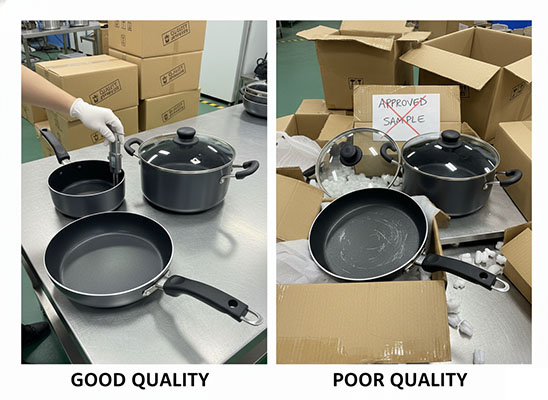
In wholesale buying, quality problems do not always appear in the obvious way. A product can look clean and attractive in a showroom photo but still create trouble after it reaches the market. For example, the cookware body may be too thin, which increases the chance of deformation. The coating may appear smooth at first, but peel faster than expected under repeated use. The handle may feel firm during a quick test but loosen under heavier load. Importers have to think like long-term sellers, not just short-term buyers.
That is why sample review should include structural checking, not just visual approval. Buyers should compare weight, inspect finish consistency, test handle strength, review lid fit, and assess carton protection. For nested cookware sets, packaging matters even more because friction damage and lid breakage can quickly destroy landed value.
| Quality area | What to check | Risk if ignored |
|---|---|---|
| Aluminum body | Thickness consistency, shape, rigidity | Warping, lower performance, more complaints |
| Coating | Smoothness, evenness, adhesion | Peeling, returns, negative reviews |
| Handle assembly | Rivets, screws, stability | Safety issues and claim exposure |
| Lid fit | Alignment, movement, seal | Lower user satisfaction and visible defects |
| Surface finish | Color and appearance consistency | Retail presentation problems |
| Packaging | Carton strength and inner protection | Transit damage and replacement cost |
This is where many orders go wrong. The cheapest supplier often looks competitive only until the after-sales costs begin. At INOXICON, our strict quality control system ensures consistency between samples and mass production. We understand that your reputation depends on every piece that reaches your customers.
How Should Importers Evaluate Aluminum Cookware Suppliers?
The right supplier is not always the lowest-priced one. The real test is whether they can produce steadily, communicate clearly, and solve problems fast.
Importers should evaluate aluminum cookware suppliers based on product specialization, export experience, quotation clarity, sample consistency, compliance support, and production control. A reliable supplier protects repeat business. A weak supplier usually creates confusion, delays, and hidden cost later.
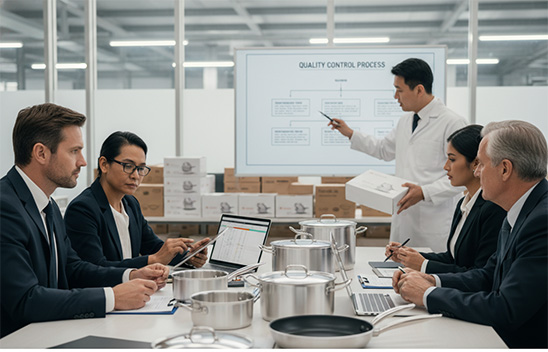
Supplier evaluation is where experience makes a major difference. On paper, many companies look similar. Their product photos are polished, their descriptions sound professional, and their prices may all fall into a similar range. But once you move from inquiry to sampling and production, the differences become clear.
A supplier that understands cookware well will ask better questions. They will clarify size tolerance, coating expectations, packing method, and target market requirements. They will not simply push a low price and hope the details can be fixed later. That behavior matters because it signals how they will perform when production pressure begins.
Buyers should also distinguish between factory, trading company, and manufacturer. A direct manufacturer can be more efficient for stable, well-defined products. A trading company may help consolidate categories, but sometimes reduces transparency. An experienced manufacturer provides value through product knowledge, quality control, and direct communication.
| Supplier evaluation point | What a strong manufacturer does |
|---|---|
| Product specialization | Understands cookware specs, not just general metal products |
| Export experience | Knows labeling, packaging, and documentation expectations |
| Communication | Responds clearly, quickly, and with useful questions |
| Sample consistency | Keeps sample quality aligned with quoted specs |
| Production control | Explains inspection steps and issue handling |
| Accountability | Discusses claims, delays, and corrective action openly |
At INOXICON, we have built relationships with over 500 clients worldwide because we focus on long-term partnerships rather than one-time transactions. Our 29 years of experience helps us understand what international buyers really need for their markets.
What Costs, MOQ, and Logistics Issues Should Buyers Understand?
A low ex-factory quote does not guarantee strong profit. Many cookware buyers lose margin through hidden costs, weak packaging, and poor freight planning.
Buyers should assess total landed cost, not only unit price. MOQ, tooling, testing, inspection, packaging, container efficiency, and shipping damage all affect the final result. A product with a slightly higher factory price can still be the smarter commercial choice.
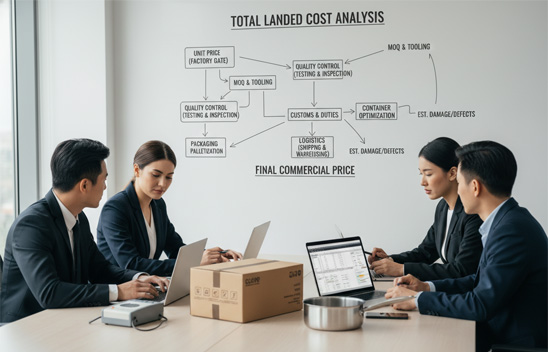
Pricing in aluminum cookware is influenced by more than the visible product. Thickness, induction base, lid quality, handle material, coating standard, logo application, and packaging format all change the cost structure. MOQ also varies. A stock item may allow smaller trial quantities, while a custom private label order may require higher minimums because of packaging setup, color control, or mold-related costs.
Then there is logistics. Aluminum cookware is light compared with some materials, but cookware still takes volume. Carton design, nesting efficiency, and protection for glass lids can strongly influence shipping cost and damage rate. A cheap product packed poorly may cost more in the end because of breakage, replacements, and customer dissatisfaction.
| Cost factor | What buyers often overlook |
|---|---|
| Tooling or mold fee | Needed for custom shapes or handle developments |
| Compliance testing | Often required before market entry |
| Inspection cost | Important for controlling shipment quality |
| Packaging upgrade | Necessary for online sellers or fragile lid protection |
| Loading efficiency | Affects freight cost per unit |
| Replacement exposure | Weak products create expensive after-sales issues |
Serious buyers review landed cost as a whole system. They do not isolate the unit price from the rest of the chain. At INOXICON, we offer flexible MOQ starting from 500 pieces for many items, helping our partners test markets without heavy inventory pressure. Our in-house production control keeps costs transparent and predictable.
What Is the Smartest Way to Import Aluminum Pots and Pans with Less Risk?
The safest orders are usually not the fastest ones. Good import results come from clear steps, written control points, and disciplined follow-up.
The smartest way to import aluminum pots and pans is to define specifications clearly, verify suppliers carefully, approve samples properly, lock quality and packaging in writing, inspect before shipment, and build repeat orders only after the first shipment proves stable.
Importing aluminum cookware successfully is not about luck. It is about sequence. Buyers who rush from quotation to deposit without controlling the basics usually create their own risk. The smarter path is structured and repeatable.
Start with a clear product brief. Then screen suppliers based on real fit, not just price or online presentation. Compare quotations carefully. Approve samples with attention to structure, coating, finish, and packaging. Confirm compliance requirements before production begins, not after. Put your specifications into written production references. Monitor progress. Inspect before shipment. Review the first order carefully before scaling up.
That process may sound simple, but it is what separates stable buyers from reactive buyers. When purchasing is treated as a system, repeat orders become easier, negotiations become stronger, and surprises become fewer.
| Step | Why it matters |
|---|---|
| Define product requirements | Creates a solid purchasing baseline |
| Shortlist and verify suppliers | Filters out weak or mismatched partners |
| Compare quotes based on real specs | Prevents false price comparisons |
| Approve samples carefully | Reduces mass production surprises |
| Confirm compliance and packaging | Protects import readiness and brand image |
| Inspect before shipment | Catches defects before they become your problem |
| Review shipment outcome | Builds a better repeat-order system |
At INOXICON, we understand this process because we have guided over 1,200 projects from concept to delivery. Our team helps buyers move through each step efficiently while maintaining quality control. With our 95 advanced machines and optimized production system, we can deliver up to 40% faster than many competitors while keeping quality consistent.
Conclusion
Aluminum pots and pans can be a profitable wholesale category, but success depends on manufacturer reliability, clear specifications, packaging control, and disciplined purchasing management from the start.