
Many aluminum cookware products look similar from the outside, but their construction methods create completely different performance results and costs.
Understanding construction differences helps cookware buyers make better sourcing decisions and avoid price comparisons that ignore quality factors. Different aluminum forming methods affect heating speed, durability, weight, and retail positioning in ways that directly impact your business success.
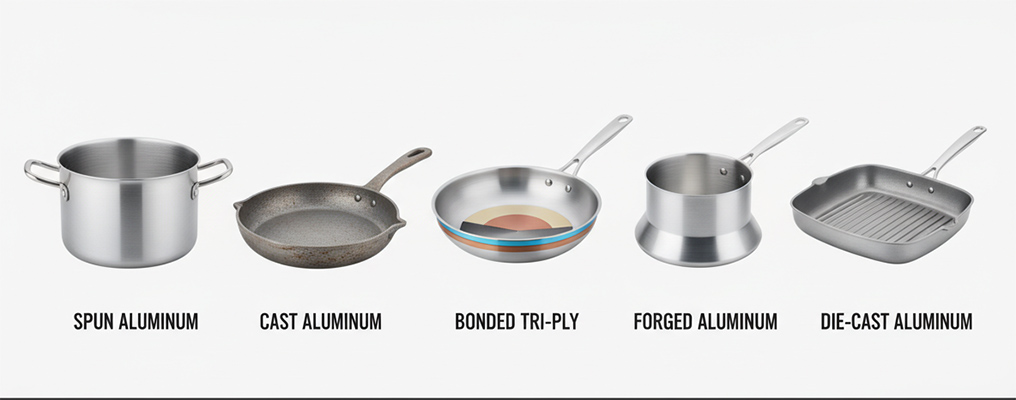
After 28 years of manufacturing aluminum cookware at INOXICON, I have seen how construction choices make or break product lines. A client once ordered 10,000 pressed aluminum pans at the lowest price, only to face returns when customers complained about warping.
Why Does Aluminum Cookware Construction Matter for Your Business?
Aluminum construction determines whether your cookware meets customer expectations or creates problems that hurt your brand.
Construction affects heat distribution, body strength, warping resistance, coating adhesion, and perceived value. The wrong choice can lead to customer complaints, returns, and damaged brand reputation even when the price seems attractive.
I remember working with a European importer who switched from forged to pressed aluminum to cut costs by 15%. Within six months, they received complaints about uneven heating and pan warping. This experience taught me that construction affects the entire customer experience. Different aluminum forming methods create different material density, thickness distribution, and structural integrity. Pressed aluminum uses sheet metal forming, which can create thin spots. Forged aluminum uses higher pressure for uniform density. Die-cast aluminum allows thicker walls and complex shapes. Each method affects heat movement, deformation resistance, and coating durability. The construction determines maximum economical thickness, affecting both performance and perceived quality.
What Is Pressed Aluminum Cookware and How Does It Perform?
Pressed aluminum cookware uses sheet aluminum shaped into pans through mechanical forming processes.
This construction method creates lightweight, affordable cookware that heats quickly but may have lower structural strength and heat retention compared to other aluminum forming methods.
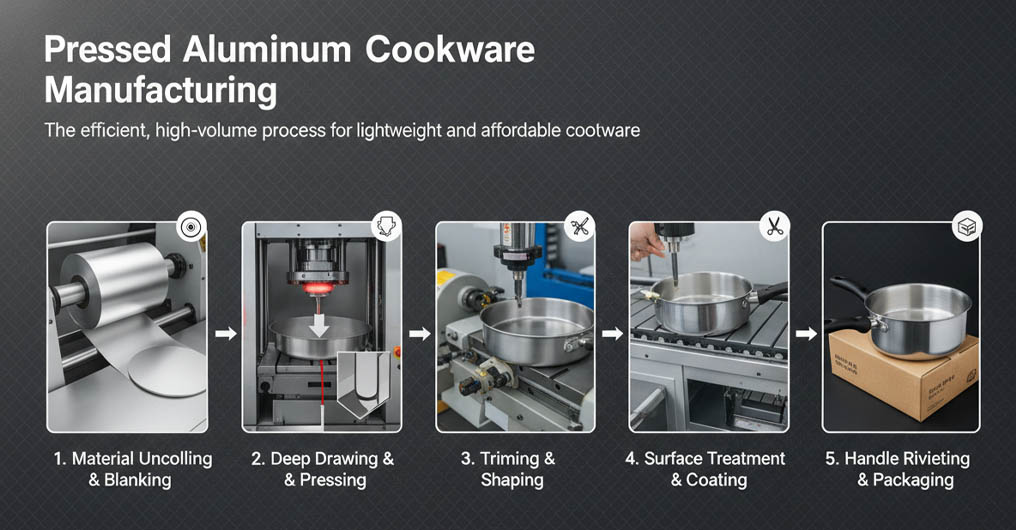
Pressed aluminum works well for entry-level products where price is primary. The process uses aluminum sheets cut into blanks and pressed into shape using dies. This allows fast production and keeps tooling costs low. However, pressing can create wall thickness variations, with some areas becoming thinner. In my experience, pressed aluminum needs at least 2.0mm thickness for adequate integrity. Thinner versions heat fast but warp on high heat. The construction works with basic nonstick coatings for light cooking like eggs and pancakes. For budget-conscious consumers, pressed aluminum offers the best entry point while maintaining reasonable performance for everyday cooking needs.
How Does Forged Aluminum Construction Change Performance?
Forged aluminum uses higher pressure during forming to create denser, stronger cookware with better heat distribution.
Forged construction creates cookware with more uniform wall thickness, better structural integrity, and improved heat retention compared to basic pressed aluminum, making it suitable for mid-range product positioning.
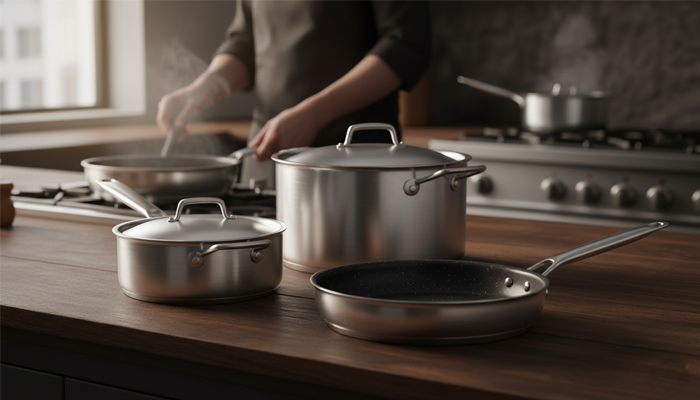
The forging process compresses aluminum under higher pressure than pressing, eliminating air pockets and creating uniform material density. This results in better heat distribution and reduces hot spots that burn food or damage coatings. Forged aluminum typically weighs 20-30% more than equivalent pressed pieces, giving consumers substantial feel without excessive weight. The stronger construction supports better coating adhesion, extending nonstick surface life. Forged aluminum works well for frying pans, saucepans, and stockpots where even heating matters. The method allows thicker walls without dramatically increasing costs, making it excellent for mid-range lines balancing performance, durability, and price. Many clients use forged aluminum for main collections because it provides noticeable quality improvements over pressed aluminum while remaining accessible to mainstream consumers.
What Advantages Does Die-Cast Aluminum Construction Offer?
Die-cast aluminum involves pouring molten aluminum into precision molds to create thick-walled, complex-shaped cookware.
Die-casting allows much thicker walls, intricate designs, and superior structural strength, resulting in cookware with excellent heat retention and premium feel that supports higher retail prices.
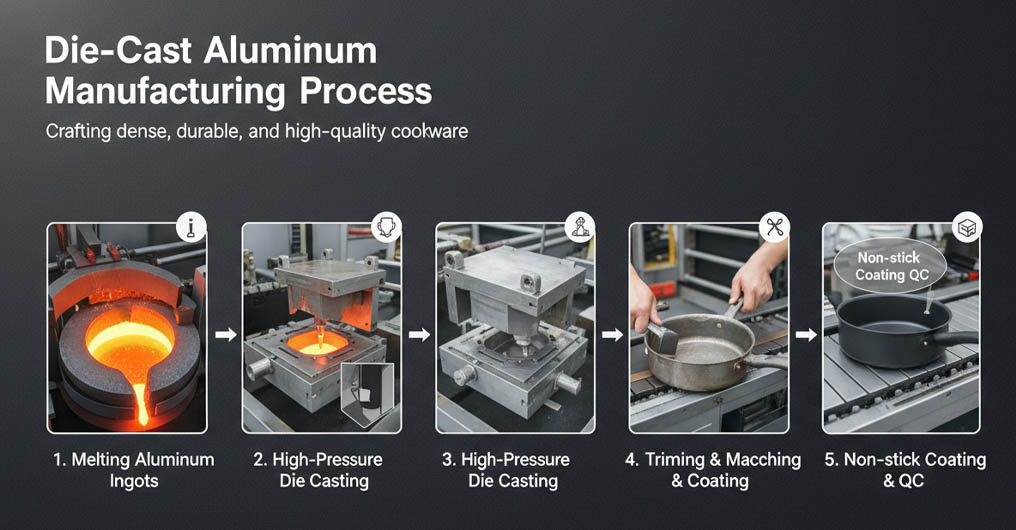
Die-casting enables designs other methods cannot achieve. The process allows 4-6mm wall thickness, creating substantial weight and excellent heat retention. Complex shapes like deep casseroles, grill pans with ridges, and multi-compartment skillets become practical. Thick walls distribute heat evenly and maintain cooking temperatures better. However, die-casting requires significant tooling investment, making it cost-effective for larger runs. I recommend die-cast aluminum for premium lines, gift sets, and specialty pieces where higher costs are justified by superior performance and appeal. The heavy feel helps position products in higher price tiers. Die-cast aluminum provides excellent support for premium coating systems. Main considerations are higher material costs, longer production times, and larger minimum quantities to justify tooling investment.
How Does Hard-Anodized Treatment Change Aluminum Cookware?
Hard anodizing is an electrochemical process that transforms the aluminum surface into a hard, non-reactive layer.
Hard anodizing creates a surface harder than stainless steel, provides better scratch resistance, and offers a distinctive dark appearance that supports premium positioning and higher retail prices.
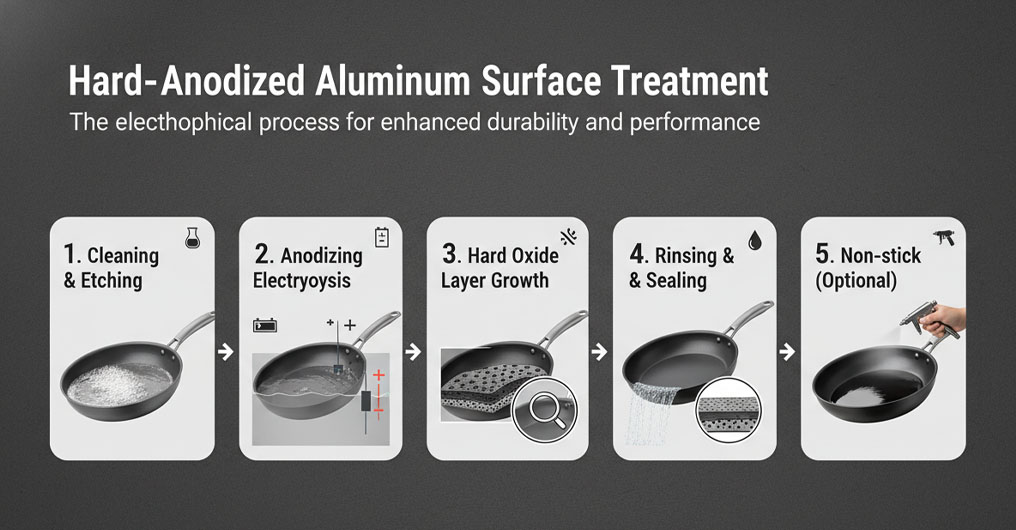
Hard anodizing creates an aluminum oxide layer integrated into the metal surface, measuring around 60 HRC on the Rockwell scale - harder than most knife blades. The treatment makes surfaces non-reactive, so acidic foods won't interact with aluminum. The dark, matte finish gives professional, modern appearance appealing to serious cooks. Hard anodizing applies to any aluminum construction, adding value to pressed, forged, or die-cast bodies. The process increases costs and lead times but enables 40-60% higher retail pricing. The surface provides excellent adhesion for premium nonstick coatings, and hardness helps coatings last longer. Some hard-anodized cookware sells without additional coating, relying on seasoning for food release. This appeals to consumers preferring surfaces without synthetic coatings while wanting aluminum's heat conduction benefits.
How Does Cookware Thickness Affect Performance and Cost?
Thickness directly impacts heat distribution, structural strength, perceived quality, and manufacturing costs across all aluminum construction methods.
Thicker aluminum cookware provides better heat retention, more even heating, superior warping resistance, and higher perceived value, but also increases material costs and shipping weights.
Thickness is critical yet often overlooked in price comparisons. Thin aluminum (1.5-2.0mm) heats quickly but creates hot spots and warps. Medium thickness (2.5-3.5mm) balances heating speed and stability. Thick aluminum (4.0mm+) offers excellent retention and distribution but heats slowly and costs more. Requirements vary by product - frying pans need adequate thickness to prevent warping, while stockpots can use thinner walls. Thickness affects coating performance, with thicker bases providing stable surfaces for better adhesion. However, each additional millimeter increases material costs 15-20% and shipping weights proportionally. The key is matching thickness to intended use and price point rather than choosing the thickest option available.
How Should Importers Choose the Right Aluminum Construction?
Selecting aluminum construction requires balancing target market needs, price points, performance requirements, and brand positioning goals.
The optimal construction choice depends on your customer base, retail channel requirements, competitive landscape, and long-term brand strategy rather than just initial purchase price.
After working with hundreds of importers, I developed a selection framework beyond cost comparison. Define your target consumer - price-focused shoppers, performance-oriented cooks, or premium loyalists. Understand retail requirements - mass merchants need aggressive pricing favoring pressed aluminum, while specialty stores support higher-value constructions. Consider competition - construction differences provide differentiation opportunities. Think long-term brand direction. Volume matters - pressed aluminum works for large volumes with simple shapes, while die-cast requires larger minimums but enables premium positioning. Hard anodizing adds lead time and quantity requirements but supports higher margins. Consider total ownership cost, including returns, customer service, and brand damage from construction problems. Sometimes paying more for better construction reduces total costs and supports sustainable growth.
Construction Selection Guide:
| Construction Type | Best For | Price Level | Key Advantage |
|---|---|---|---|
| Pressed aluminum | Budget lines, promotions | Low | Lowest cost, fast production |
| Forged aluminum | Mid-range family cookware | Medium | Better strength and value balance |
| Die-cast aluminum | Premium nonstick lines | Medium-High | Superior structure, complex shapes |
| Hard-anodized aluminum | High-end positioning | High | Professional appearance, durability |
Conclusion
Different aluminum cookware constructions create distinct performance profiles and market opportunities. Understanding these differences helps importers make decisions aligned with brand goals and customer needs rather than choosing solely on price.