
Bad Amazon reviews killing your cookware sales? Common complaints like rust and warping can destroy a listing. The solution lies in product details, not just customer service.
Key cookware features that reduce negative Amazon reviews include the right stainless steel grade, a stable bottom, secure handles, smooth finishing, a precise lid fit, and FBA-ready packaging. These details prevent common complaints before they happen.
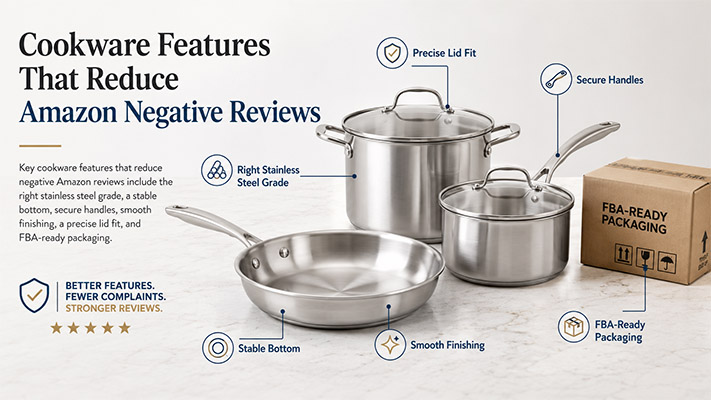
In my 29 years manufacturing kitchenware, I've seen countless products succeed or fail based on small details. Many bad reviews aren't about major defects; they're about choices made during development. Let’s look at the most common complaints and how to prevent them at the source, long before your product reaches an Amazon warehouse.
Why Do Rust Spots Still Create Bad Reviews on Stainless Steel Cookware?
Seeing rust complaints on your stainless steel cookware? Buyers immediately lose trust, thinking your product is cheap or fake. The right material and finish can prevent this damage.
Stainless steel cookware gets rust complaints from using the wrong steel grade, poor polishing, leftover factory residue, or moisture trapped in packaging. To a customer, any brown mark is “rust,” instantly damaging their perception of your product’s quality.
From my experience, I can tell you that stainless steel isn't completely rust-proof, it's rust-resistant. In a real kitchen, a buyer might leave salty water or acidic sauce on the surface. If the finish is even a little bit rough or wasn't perfectly cleaned at the factory, stains can appear. The customer won’t write a review saying, “I may have left residue on the pan.” They will write, “This pan rusted after one use.” That one-star review can stop hundreds of future sales. You can't explain technical details in your product listing to fix a bad review. You have to prevent the problem from the start.
At INOXICON, we learned this lesson early on. Preventing a rust complaint is much easier than trying to fix it later.
How can you prevent rust complaints?
| Review Problem | Detail to Check with Your Supplier | Why It's Critical for Amazon |
|---|---|---|
| Rust spots | The stainless steel grade (e.g., 304 vs. 201) | A better grade offers more corrosion resistance. |
| Brown stains | The quality and consistency of the polishing | A smoother surface is easier to clean and traps less residue. |
| Black marks | The post-production cleaning process | Factory residue looks like a defect to the customer. |
| Water marks | If the packaging is sealed and dry | Trapped moisture can cause stains during shipping and storage. |
How Can Cookware Reduce Warping Complaints on Amazon?
Is your cookware getting complaints about warping or spinning on the stove? Buyers see this as a sign of cheap, poor-quality manufacturing, and they will leave a negative review.
To reduce warping complaints, cookware needs a thick enough bottom, a stable body structure, and a flat base, especially for induction use. These features prevent the pan from deforming under high heat, which is a major source of customer dissatisfaction.
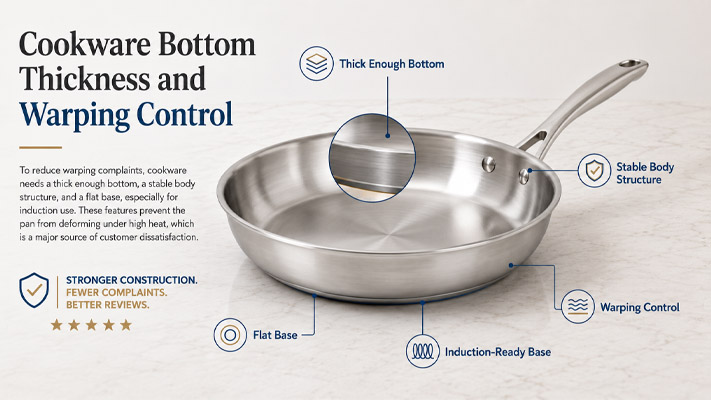
A warped pan is more than just a defect; it's a frustrating user experience. It causes uneven cooking and makes the product feel flimsy and unsafe. This is especially true with induction cooktops, which heat up incredibly fast. If a pan isn't built for that thermal stress, it will bend. I've seen online discussions where users share photos of their pans rocking on the stove. This is a very visible failure that immediately tells other potential buyers to avoid your product.
As a manufacturer, we know it's a balancing act. You want to control costs, but making the base too thin is a huge risk. A good sample isn't enough. You must ensure that every single piece from mass production maintains its flatness and structure.
How can you prevent warping complaints?
| Review Problem | Detail to Check with Your Supplier | Why It's Critical for Amazon |
|---|---|---|
| Pan warping | The bottom thickness and material layers | Thicker bases distribute heat better and resist bending. |
| Pan spins on stove | The flatness of the base after production | Induction users will notice an uneven base immediately. |
| Uneven cooking | The heat distribution of the base | Warping creates hot spots and leads to food burning. |
| Feels cheap/thin | The gauge of the cookware body | Customers associate weight with quality and durability. |
Why Do Handles Cause So Many Negative Reviews?
Worried about one-star reviews from loose or uncomfortable handles? This is a common problem because a bad handle makes the entire product feel unsafe and poorly made.
To avoid negative reviews, cookware handles must have strong riveting or welding, smooth edges, and a comfortable grip. Because customers interact with the handle every time they cook, any weakness here is noticed immediately and is often linked to safety concerns.
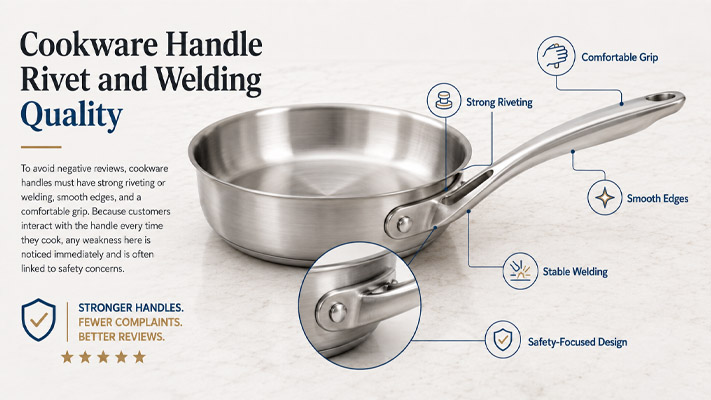
A handle complaint is one of the most serious you can get. It's not about appearance; it's about safety. When a customer picks up a pot full of hot liquid, a wobbly handle is terrifying. Even if the pot itself is high quality, a handle that feels sharp, thin, or loose can ruin the product's reputation. I have seen countless listings destroyed by this single issue.
There are two main types: riveted and welded. Rivets look strong, but they must be perfectly tight. Welded handles look clean, but the weld must be high quality to last. Trying to save a few cents on the handle is a terrible business decision. You can't see the rivet pressure or weld quality in a product photo, so you have to trust your manufacturing partner.
How can you prevent handle complaints?
| Review Problem | Detail to Check with Your Supplier | Why It's Critical for Amazon |
|---|---|---|
| Handle is loose | The riveting strength or welding quality | This is a major safety concern for customers. |
| Handle feels cheap | The thickness and weight of the handle material | A flimsy handle makes the whole product feel low-quality. |
| Grip is uncomfortable | The ergonomic shape and edge finishing | Sharp edges or a bad shape lead to a poor user experience. |
| Handle gets too hot | The handle material and design | If the handle isn't heat-resistant, it's a usability failure. |
How Can Surface Finish Reduce Scratch and Sticking Complaints?
Tired of reviews complaining that your cookware scratches easily or is hard to clean? The surface finish is your first line of defense against these common customer frustrations.
A good surface finish reduces negative reviews by looking clean, feeling smooth, and resisting scratches. For stainless steel, a smoother interior polish can make cleaning easier and reduce food sticking, even for buyers new to this type of cookware.
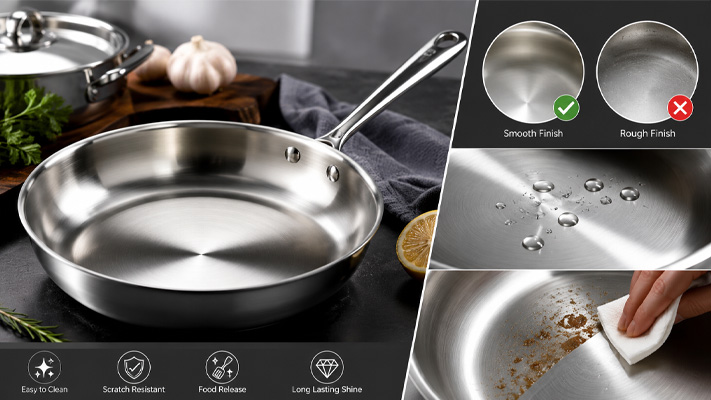
Many customers moving from nonstick to stainless steel are not expert cooks. They expect an easy experience. If food sticks, they blame the pan, not their cooking technique. If the surface gets a scratch during the first use, they call it "low quality" and upload a picture. I've seen this happen again and again. While part of this is about educating the customer, the product itself must be forgiving. A rough interior polish will make sticking worse and cleaning harder. This creates a bad first impression that often ends up as a negative review.
At INOXICON, we develop over 50 new designs a year, and the surface finish is always a key discussion. A beautiful, mirror-like finish that scratches the moment you touch it can be worse than a standard brushed finish.
How can you prevent surface complaints?
| Review Problem | Detail to Check with Your Supplier | Why It's Critical for Amazon |
|---|---|---|
| Food sticks easily | The smoothness of the interior polishing | A rougher surface can increase the chance of food sticking. |
| Arrived scratched | The protective packaging between pieces | Scratches from shipping look like the product was used. |
| Hard to clean | The quality of the interior finish | A surface that holds onto stains is a daily frustration. |
| Looks cheap | The consistency of the finish across the product | Uneven polishing makes the product look defective. |
Why Do Lid Fit and Induction Compatibility Need Extra Testing?
Getting returns because a lid rattles or a pan doesn't work on an induction stove? These are "false advertising" claims in a customer's eyes and can quickly damage your listing.
To avoid these complaints, you must verify the lid fit on every pot size and test induction compatibility on actual cooktops. A rattling lid or a non-working pan feels like a broken product and leads directly to returns and bad reviews.
These details seem so small, but they cause big problems. A customer expects a lid to sit flat and feel secure. If it slides around or lets too much steam escape, they don't think "loose tolerance"; they think "this is defective." The problem gets worse with cookware sets—one bad lid can lead to a negative review for the entire set.
Induction compatibility is even more critical. If your listing says "works on all stovetops," you are making a promise. Induction users will test that promise on day one. If the pan doesn't heat up, heats slowly, or makes a buzzing noise, they will feel misled. This is not just a bad review; it's a breach of trust.
How can you prevent fit and compatibility complaints?
| Review Problem | Detail to Check with Your Supplier | Why It's Critical for Amazon |
|---|---|---|
| Lid doesn't fit | The diameter tolerance of the pot rim and lid | An improper fit makes the product feel broken. |
| Lid shakes/rattles | The shape of the lid and how it sits on the pot | This gives an impression of poor craftsmanship. |
| Not induction ready | The magnetic properties of the base material | This is a direct claim that customers will test. |
| Heats slowly on induction | The design and flatness of the induction base | Poor performance feels like a defect, not just a feature. |
How Can Packaging Reduce "Arrived Damaged" Reviews?
Are your products arriving scratched, dented, or with broken lids? Your packaging is failing, and customers will blame your product, not the shipping carrier, with a one-star review.
Good packaging protects cookware from shipping damage and improves the customer's first impression. For Amazon FBA, this means using strong cartons and inner protection to prevent dents, scratches, and broken parts from warehouse handling and delivery.
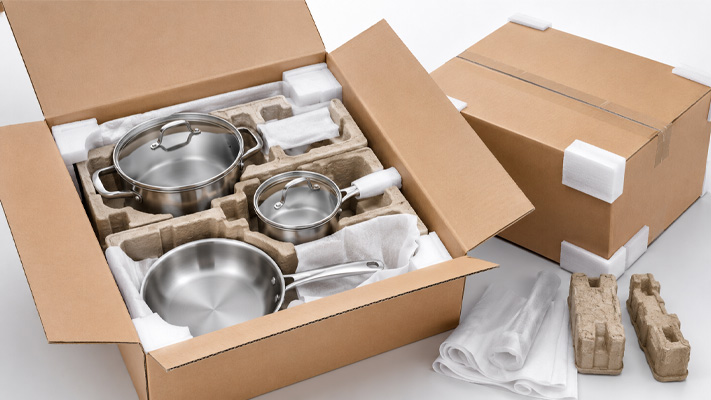
From my two decades of exporting, I can tell you that Amazon's fulfillment process is tough on products. Your cookware will be moved, stacked, and dropped. If the pieces can rub against each other inside the box, they will arrive scratched. If a glass lid isn't secured, it will break. If the box is flimsy, it will be crushed. The customer doesn't care what happened in the warehouse. They see a damaged product and immediately request a refund and leave a negative review.
But packaging is also about perception. A strong, well-designed box makes the product inside feel more valuable. A messy box with loose parts makes even a high-quality item feel cheap. When we work on OEM projects, I always tell my clients that the packaging is part of the product. It's the first thing your customer touches.
How can you prevent packaging complaints?
| Review Problem | Detail to Check with Your Supplier | Why It's Critical for Amazon |
|---|---|---|
| Arrived dented/damaged | The carton strength and drop-test results | FBA requires packaging that can survive rough handling. |
| Surface is scratched | The inner protection between each piece | Metal-on-metal contact during shipping causes scratches. |
| Glass lid is broken | The specific protection used for fragile parts | A broken lid is a clear reason for a one-star review. |
| Unboxing feels cheap | The layout and quality of the inner packaging | A good unboxing experience increases perceived value. |
Conclusion
Negative reviews are preventable. Focusing on material, construction, handle security, surface finishing, and FBA-ready packaging protects your brand and builds trust with Amazon customers from the very first order.